Adhan vs Iqamah: what's the difference and why it matters
The Adhan is the call to prayer that marks the start of a prayer's time; the Iqamah is the second call, made as the congregation stands. To pray in congregation, go by the Iqamah time.
On this page
The Adhan is the call to prayer: it announces that the time for a prayer has begun. The Iqamah is a second, shorter call made just before the prayer starts, when the congregation lines up. On a mosque timetable, the Adhan column tells you when the prayer's time opens and the Iqamah column tells you when the jamaʼah will actually stand. If you want to pray with the congregation, plan around the Iqamah.
The Adhan: the prayer's time has begun
The Adhan (أذان) is called five times a day, at the start of each prayer's time: Fajr, Dhuhr, Asr, Maghrib and Isha. Its words proclaim God's greatness and invite people to prayer and to success. At Fajr, many callers add a line reminding the listener that prayer is better than sleep.
Because each prayer's time is defined by the sun, the Adhan time can be calculated for any place and date. That is how prayer-time apps, printed calendars and mosque timetables arrive at it, and why they sometimes differ slightly depending on the calculation convention they use. We cover that in How prayer times are calculated.
The Iqamah: the congregation stands
The Iqamah (إقامة, meaning "establishing") is called inside the mosque immediately before the congregational prayer. Its words closely follow the Adhan, with the added phrase qad qāmati ṣ-ṣalāh, "the prayer has begun". Once it is called, the rows form and the imam begins.
The Iqamah time is a decision, not a calculation. Each mosque chooses it, taking into account:
- time for people to arrive after hearing the Adhan, and to make wudu
- the voluntary (sunnah) prayers many people pray before some obligatory ones
- the working day, school runs and, for Fajr and Isha, the season
- local custom and the mosque's own school of thought
Some mosques keep a fixed gap after the Adhan; others fix the Iqamah at a round clock time and change it every few weeks as the days lengthen or shorten.
How long is the gap?
There is no single answer. Maghrib is commonly prayed soon after its Adhan, because its time is relatively short, while the gap at the other prayers is often longer. Fajr may have a longer gap still in some mosques. But the only reliable figure is your own mosque's timetable.
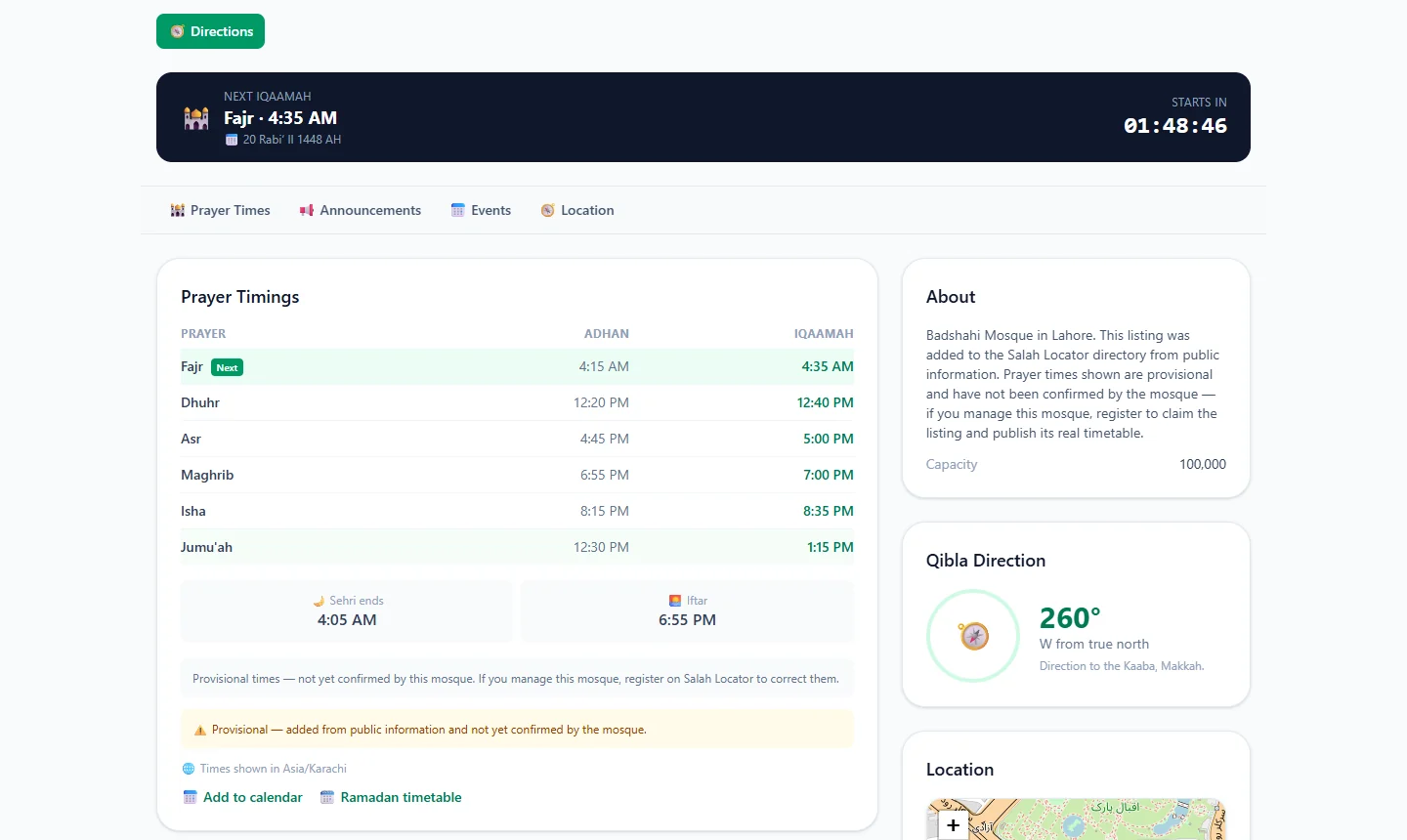
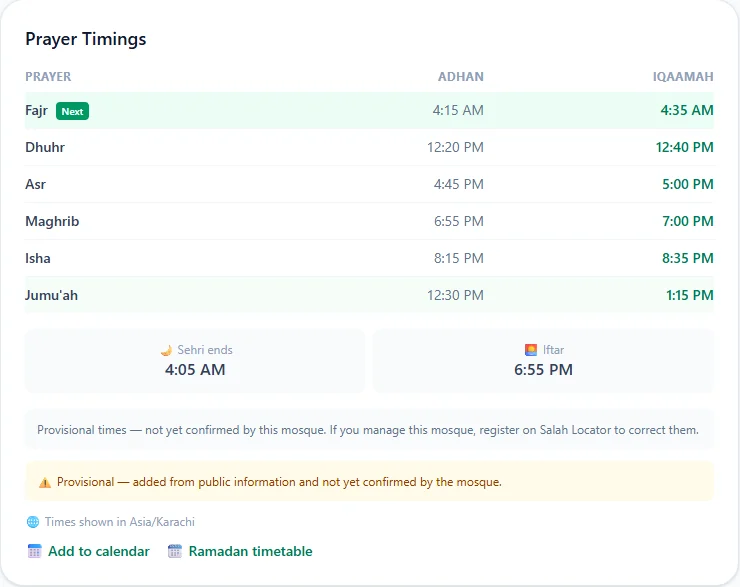
That is why a good timetable shows both columns side by side.
Jumuʼah is a little different
On Fridays, the Jumuʼah prayer replaces Dhuhr for those who attend it. The Adhan is followed by the khutbah (sermon), and the Iqamah is called after the khutbah, just before the two-rakʼah prayer. Some mosques call two Adhans for Jumuʼah and many hold more than one congregation. So the Jumuʼah Iqamah can be quite a bit later than the Adhan, and it is the time to aim for if you want to hear the whole khutbah and then pray. Why Jumuʼah times differ between mosques explains more.
Which time should you use?
To pray in congregation: the Iqamah, with a margin. Arriving before the Iqamah gives you time to make wudu, pray any sunnah and join the first rows.
To pray alone, at home or at work: once the prayer's time has begun, you can pray. The Adhan time tells you that it has. Each prayer's time then lasts for a set period: Fajr's ends at sunrise, for example, and scholars differ on exactly when the times of Asr and Isha end. There is usually no need to rush, though praying early in the time is widely encouraged.
For reminders: choose based on what you want the reminder to do. A reminder at the Adhan tells you the time has started; a reminder at the Iqamah is more useful if you are already at the mosque or very close to it. In Salah Locator you choose between them with Remind me at: Adhan / Iqaamah on a mosque's alarm screen.
Why most apps only give you the Adhan
A prayer app can calculate the Adhan for any point on earth, because the sun is the same for everyone. It can't calculate the Iqamah. Only the people who run a mosque know when its congregation stands, and those times change with the seasons, with Ramadan, and sometimes from one week to the next.
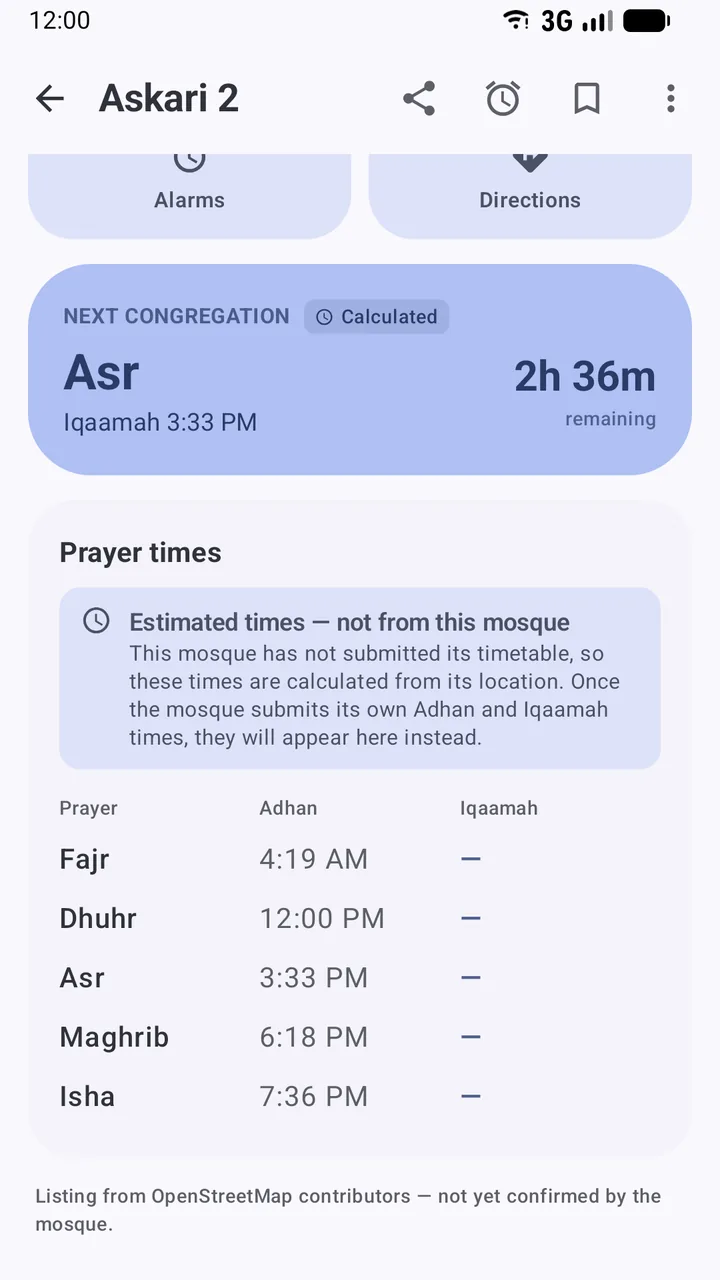
This is the gap Salah Locator was built to close. Mosques publish their own Adhan and Iqaamah times, and the app shows exactly what they entered, with a note saying whether the times came from the mosque, from a correction by someone who prays there, or from public information not yet confirmed. Where a mosque hasn't published anything, the app calculates the Adhan times, marks them Estimated times — not from this mosque, and leaves the Iqaamah column empty rather than invent one.
The Pray Now feature goes a step further: it compares the Iqaamah times of the mosques around you and shows which congregation you can still catch. See Use Pray Now to catch a congregation.
Etiquette worth remembering
- Listen and respond to the Adhan. Many Muslims repeat the words of the Adhan quietly as they hear them.
- Don't arrive at the Iqamah on the dot if you can help it. Walking in as the imam begins is fine; running to catch it isn't encouraged.
- Check the mosque's times when you travel. A mosque in another city, or another country, may keep a very different gap between the two calls.
A note on spelling
You'll see this word spelled Iqamah, Iqama, Iqaamah and Ikamah. They are all transliterations of the same Arabic word. Salah Locator uses Iqaamah, and most search engines treat them as the same thing.
Whichever spelling your mosque uses, the principle is the same: the Adhan opens the door, and the Iqamah is when the congregation walks through it together.
Frequently asked questions
Is the Adhan time the same as the prayer time?
The Adhan marks the beginning of the prayer's time. You may pray at any point during that time, but a congregation begins at the Iqamah, which is usually some minutes after the Adhan.
How long is the gap between Adhan and Iqamah?
Each mosque decides. It is often short at Maghrib and longer at the other prayers, and it may change with the seasons. Check your mosque's timetable rather than assuming a fixed gap.
Why do most prayer apps only show Adhan times?
Adhan times can be calculated from the sun. Iqamah times can't: only the mosque knows when its congregation stands, so an app can only show them if the mosque publishes them.
Is it Iqamah, Iqama or Iqaamah?
They are all transliterations of the same Arabic word, إقامة. Salah Locator writes Iqaamah; Iqamah and Iqama are also common.
If I'm praying at home, should I use the Adhan or the Iqamah time?
At home you can pray once the prayer's time has begun, which is the Adhan time. Many people still use their mosque's Iqamah as a daily routine.
Was this post helpful?