Why Jumuʼah times differ from one mosque to the next
Jumuʼah is prayed in the time of Dhuhr, but each mosque sets its own Adhan, khutbah and Iqamah. Clock changes, khutbah length, space and local working hours explain most of the difference.
On this page
- What makes up Jumuʼah
- Reason 1: a fixed clock time versus the sun
- Reason 2: summer time
- Reason 3: the length and language of the khutbah
- Reason 4: space, and a second jamaat
- Reason 5: working hours and school hours
- Reason 6: shared and temporary venues
- How to know your mosque's actual time
- Visiting a new mosque for Jumuʼah
- For mosque committees
Jumuʼah is prayed in the time of Dhuhr, but its actual start time is set by each mosque. One mosque may call the Adhan at 1:00 PM with the congregation standing at 1:30, while the next holds two jamaats at 12:45 and 2:00. The differences come from the clock, the length of the khutbah, the size of the building and the working lives of the people who attend. The only reliable time is the one your mosque publishes.
What makes up Jumuʼah
On Friday, the Jumuʼah prayer takes the place of Dhuhr for those who attend it. It has three parts, and a mosque timetable may show a time for each:
- The Adhan. Some mosques call two: the first to announce that Jumuʼah is near, and the second as the imam sits on the minbar before the khutbah.
- The khutbah. A sermon in two parts, delivered by the imam. In many countries it is preceded or accompanied by a talk in the local language.
- The Iqamah and prayer. After the khutbah the Iqamah is called and the congregation prays two rakʼahs.
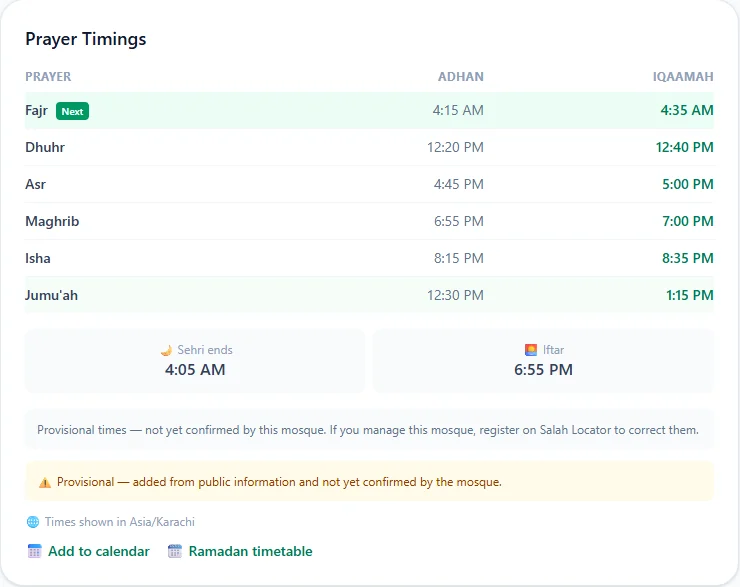
So when you see "Jumuʼah 1:30 PM", it could mean the Adhan, the start of the khutbah or the prayer itself. That alone explains a lot of confusion. A good timetable gives the Adhan and the Iqamah separately, and Salah Locator shows both.
Reason 1: a fixed clock time versus the sun
Dhuhr begins just after solar noon, which drifts across the clock through the year by up to about half an hour, and differs between the east and west of a large time zone. Some mosques move Jumuʼah with it. Many prefer a fixed clock time, such as 1:15 PM all winter and 1:45 PM all summer, because people can plan their working week around it. Two mosques in the same town can therefore be a quarter of an hour apart simply because one follows the sun and the other the clock.
Reason 2: summer time
In countries that put the clocks forward in summer, solar noon jumps an hour later on the clock overnight. Mosques in those countries usually move Jumuʼah by an hour on the same weekend. Those that change a week earlier or later than others, or change by half an hour in two steps, will be out of line with their neighbours for a while.
Reason 3: the length and language of the khutbah
The khutbah itself is short, but many mosques add a longer talk before it, often in the language most of the congregation speaks, with the Arabic khutbah following. A mosque with a 30-minute talk before the khutbah may call its first Adhan earlier, or put its Iqamah later, than one that goes straight to the Arabic khutbah.
Reason 4: space, and a second jamaat
Friday brings far more people than any other day. When the prayer hall can't hold everyone, mosques hold a second, and sometimes a third, jamaat. The first is often early to suit people on a short lunch break; the later one catches those who can't leave work until later. On Salah Locator, a second congregation appears as a second Iqamah in the Jumuʼah row (1:15 PM / 2:00 PM on the website, or a Jumuʼah 2 row in the app).
Reason 5: working hours and school hours
In countries where Friday isn't a weekend day, a mosque near offices will choose a time that fits a lunch hour. A mosque near a university may follow the lecture timetable. A mosque in a residential area may choose a later time that suits families. There's no "right" answer; each committee is serving its own congregation.
Reason 6: shared and temporary venues
Some congregations pray Jumuʼah in a rented hall, a school or a community centre, and must fit around the building's other bookings. These times can change at short notice, which is exactly the kind of thing a mosque should post as an announcement.
How to know your mosque's actual time
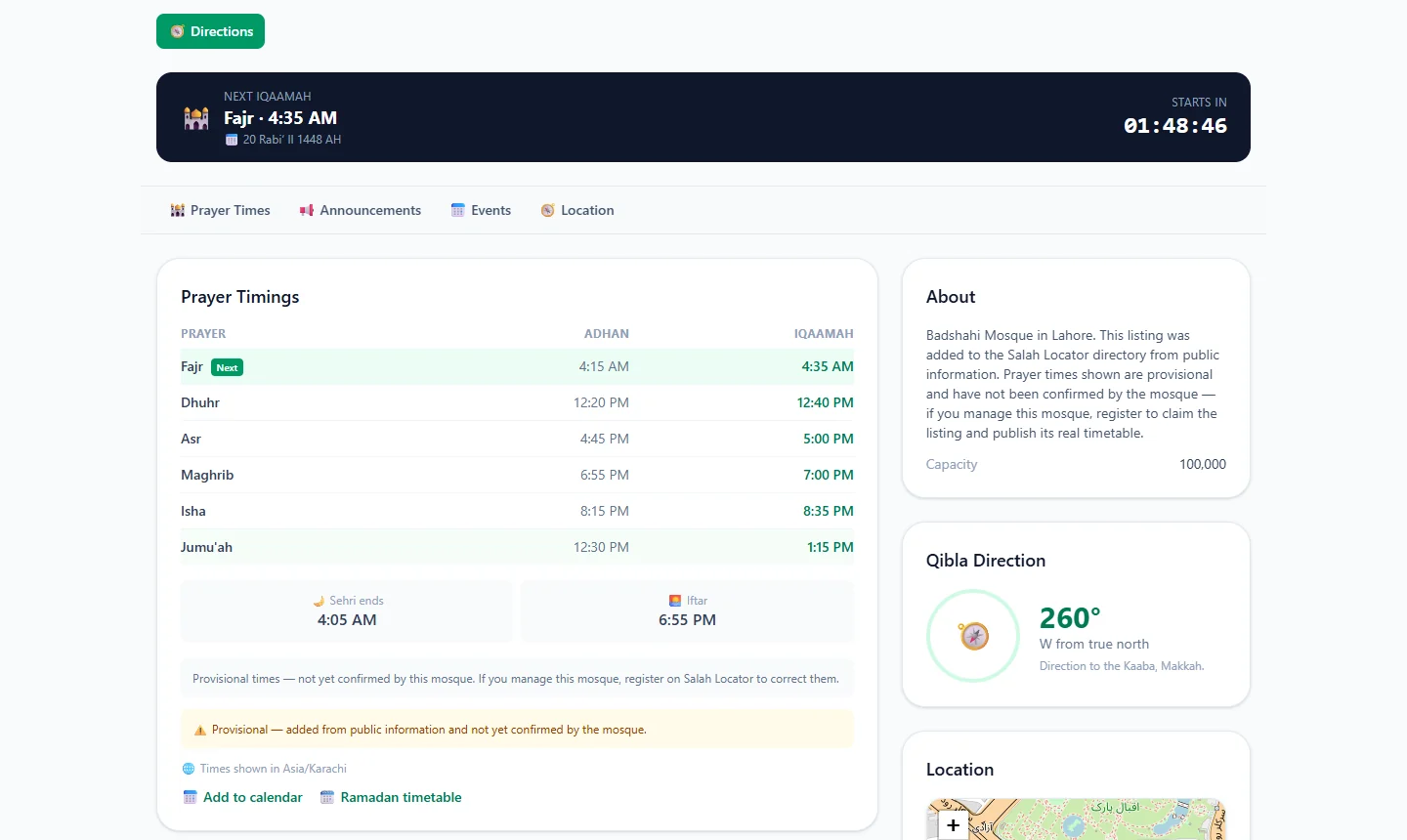
- Look for both times. The Jumuʼah row on a Salah Locator mosque page shows the Adhan and the Iqamah. To hear the whole khutbah, arrive before the Adhan time.
- Check the source. A timetable marked Published by the mosque. was entered by the mosque itself. Provisional means it came from public information and hasn't been confirmed.
- Check for seasonal changes. If a mosque is on a Ramadan or winter timetable, Special timings in effect appears above the table, and the Jumuʼah time may be different from usual.
- Save the mosque. Saving it in Salah Locator follows it, so an announcement about a changed time reaches you as a notification and an email.
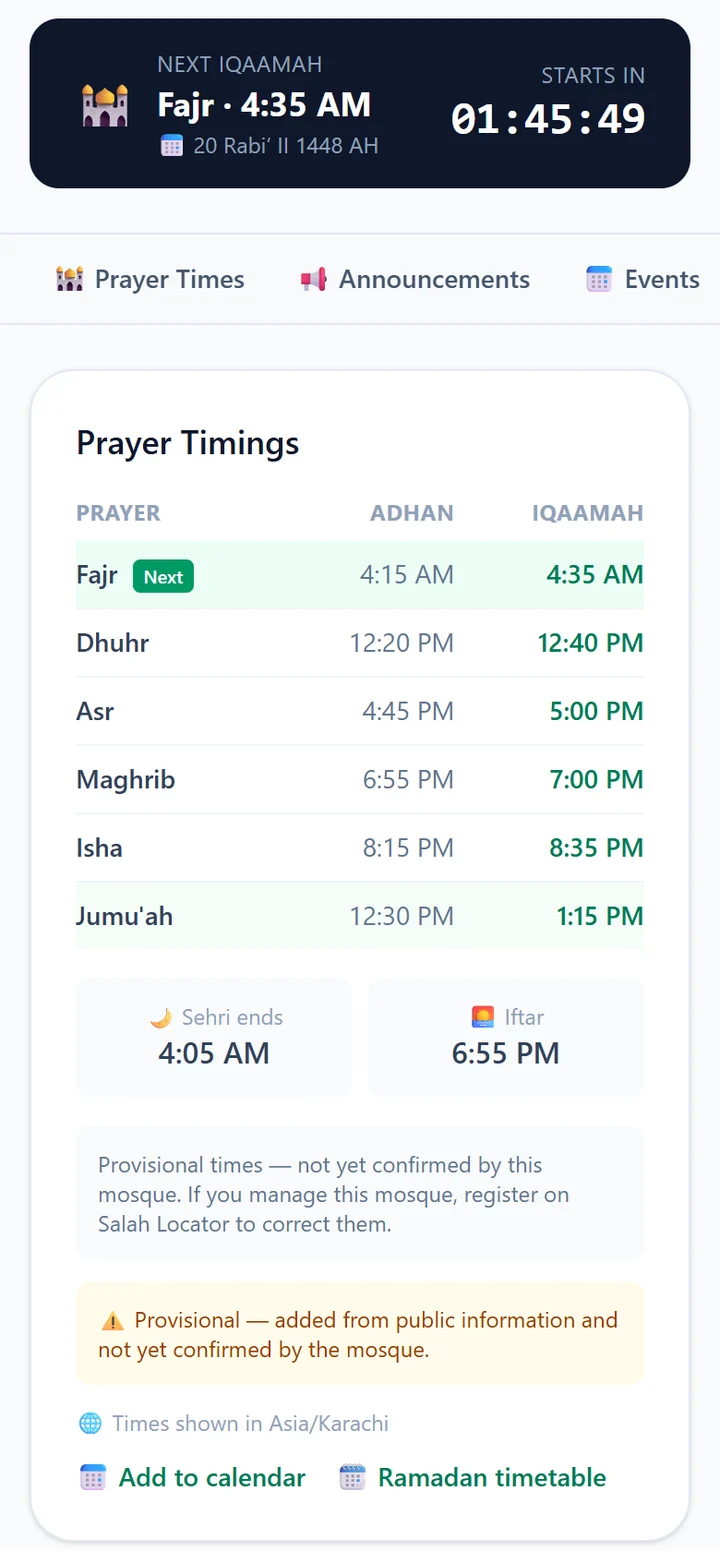
One thing to watch: on a Friday, the next-prayer countdown, Pray Now and prayer reminders in Salah Locator follow the daily Dhuhr time, not Jumuʼah. Always check the Jumuʼah row itself before you set off. The details are in Find Jumuʼah, Ramadan, Tarawih and Eid prayer times.
Visiting a new mosque for Jumuʼah
If you are travelling, or trying a mosque for the first time:
- Arrive early. Friday is busy, parking fills up and the first rows go quickly.
- Check the facilities on its listing, such as parking, a wudu area or a women's section.
- If it streams the khutbah, you may be able to see how long its programme usually runs.
- If the time on the listing looks wrong, tell the mosque. In the Salah Locator app, Report a wrong prayer time asks the mosque to confirm a correction.
For mosque committees
A clear Jumuʼah listing saves a lot of phone calls. Publish the Adhan and the Iqamah separately, add the second jamaat if you hold one, and update both on the weekend the clocks change. Use the timetable's Notes for a one-off change, and an announcement for anything bigger. Putting your mosque's prayer times online has a fuller checklist.
For the difference between the two calls themselves, read Adhan vs Iqamah.
Frequently asked questions
Is Jumuʼah at the same time as Dhuhr?
Jumuʼah is prayed in the time of Dhuhr and takes its place for those who attend. Its actual start depends on the mosque: the Adhan, the khutbah and the Iqamah are all set locally, so it is usually later than the earliest Dhuhr time.
Why does my mosque hold two Jumuʼah prayers?
Usually because one congregation doesn't fit in the building. A second jamaat lets more people attend, and can suit people with different lunch breaks.
What is the difference between the Jumuʼah Adhan and Iqamah?
The Adhan is followed by the khutbah (sermon). The Iqamah is called after the khutbah, just before the prayer itself. To hear the whole khutbah, arrive before the Adhan time.
Why did the Jumuʼah time change when the clocks changed?
The sun doesn't change when the clocks do. In countries with summer time, solar noon moves an hour later on the clock, so many mosques move Jumuʼah by an hour too.
Was this post helpful?