Find Jumuʼah, Ramadan, Tarawih and Eid prayer times
In short
Jumuʼah has its own row in each mosque's timetable. In Ramadan a mosque can switch to a seasonal timetable and publish Sehri, Iftar, Tarawih and Eid times, which appear as the dates approach.
On this page
Jumuʼah has its own row at the bottom of every mosque's timetable in Salah Locator, with the Adhan, the Iqaamah and a second Iqaamah where the mosque holds two. For Ramadan, a mosque can switch to a seasonal timetable for a set range of dates and publish its Sehri and Iftar times, nightly Tarawih and Eid prayers. These appear on the mosque's page only when they are relevant.
Jumuʼah (Friday prayer)
Open the mosque and scroll to the last row of Prayer Timings. It shows:
- the Adhan time for Jumuʼah
- the Iqaamah time, when the congregation stands after the khutbah
- a second Iqaamah if the mosque holds two congregations: on the website both appear together (for example 1:15 PM / 2:00 PM), and the app adds a Jumuʼah 2 row
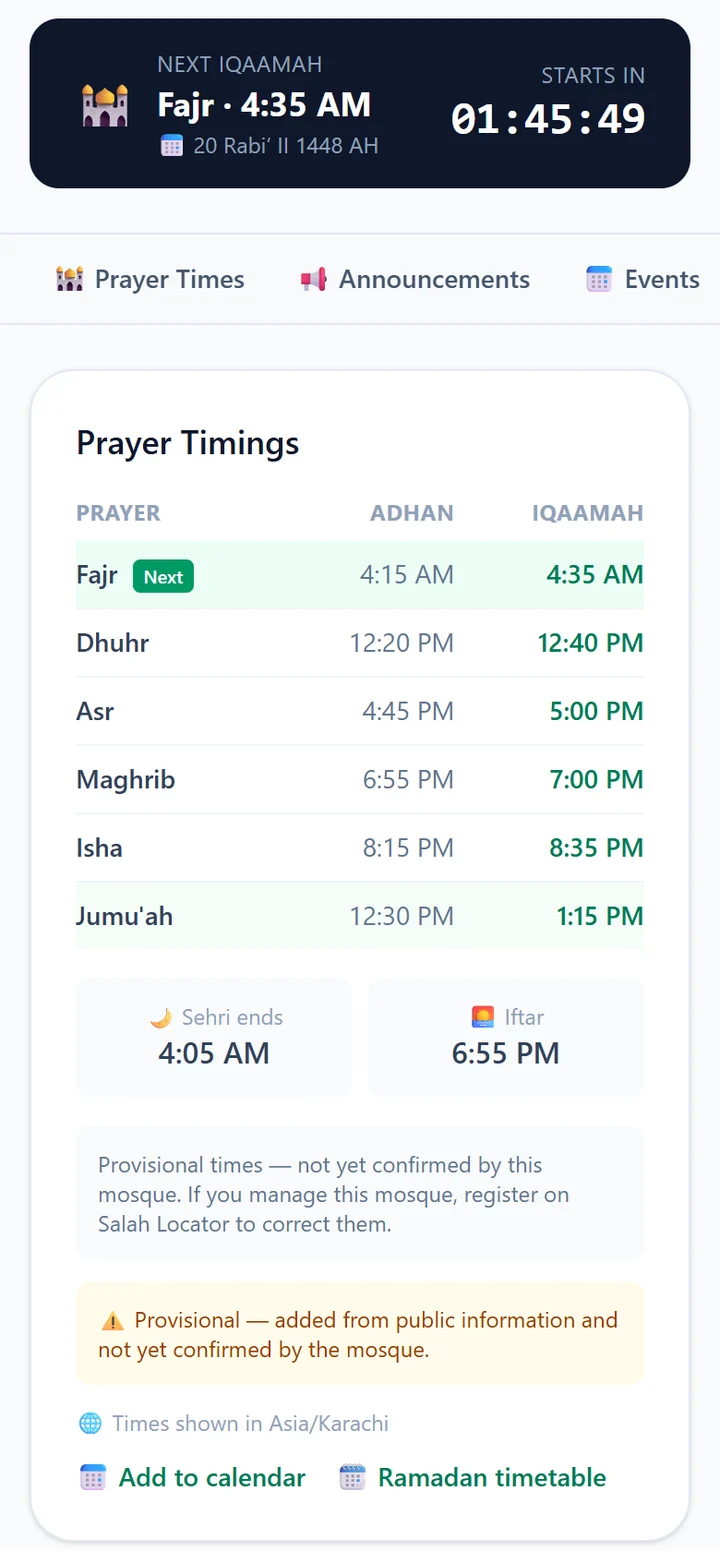
The next-prayer countdown, Pray Now and prayer reminders are built from the five daily prayers, so on a Friday they follow Dhuhr. Check the Jumuʼah row itself before you set off. If the mosque streams the khutbah, you'll find it under Live streams; see announcements, events and live streams.
Seasonal timetables for Ramadan and winter
Many mosques change their times for Ramadan or for the winter months. An administrator can publish a seasonal timetable for a date range, and while it is in force:
- the website shows Special timings in effect, with its name (for example Ramadan 1447) and the date it runs until
- the app shows the seasonal timetable's name above the times
- the times on the page, your reminders and the home-screen widget all follow the seasonal times
Where the mosque left a prayer blank in the seasonal timetable, its usual time still applies.
Sehri and Iftar
Sehri ends and Iftar appear under the timetable. Unless the mosque sets them itself:
- Sehri ends is the Fajr Adhan minus the mosque's Imsak buffer, which is 10 minutes unless the mosque changes it
- Iftar is the Maghrib Adhan time
A mosque can also set exact Sehri and Iftar times, for its usual timetable or for a seasonal one. Scholars and communities differ on these margins, so if you are unsure, follow your own mosque.
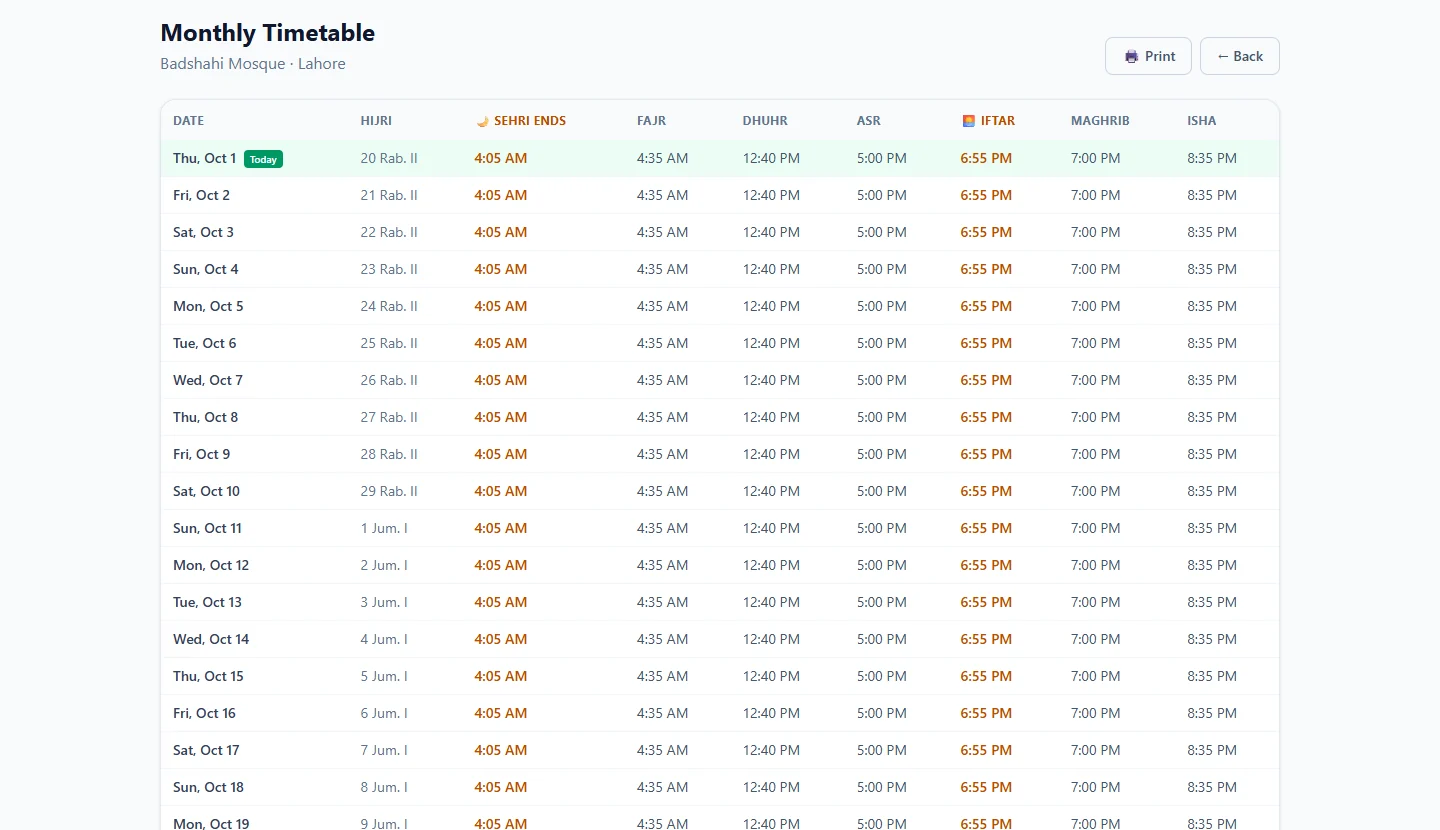
Print a Ramadan timetable
- Open the mosque's page on sl.abdohoo.app.
- Under Prayer Timings, tap 🗓 Ramadan timetable.
- The page lists every day of the mosque's current or next seasonal timetable. If it has none, it shows this month as a Monthly Timetable.
- Tap 🖨 Print. The site's header and footer are left off the printout.
Tarawih
Tarawih appears on a mosque's page during Ramadan and in the three weeks or so before it. You'll see the start time, the number of rakʼahs, the Hafiz or Imam, the dates and a badge: Starting soon before the first night and On now during it. On the website, Tonight shows the night number and the juzʼ being recited, and Khatm schedule opens the plan for every night. The app shows the same under 🌙 Tarawih, with Tonight and the juzʼ.
During Ramadan, the website's Pray Now page also lists Tarawih tonight at nearby mosques.
Eid prayers
Eid prayers appear under Eid Prayers as their date approaches, with the date, every jamaat time, the venue if it isn't the mosque itself, and any notes. On the day, the website marks the entry Today.
For timing your fast, see Suhoor and iftar times: a practical guide. If you run a mosque, Update your mosque's prayer timings shows how to publish all of this.
Frequently asked questions
Where do I find a mosque's Friday prayer time?
Open the mosque and look for the Jumuʼah row at the bottom of its timetable. It shows the Adhan and the Iqaamah, and a second Iqaamah if the mosque holds two congregations.
How is the Sehri time worked out?
Unless the mosque sets its own, Sehri ends a set number of minutes before the Fajr Adhan (10 minutes by default, and the mosque can change it), and Iftar is the Maghrib Adhan time.
When do Tarawih and Eid times appear?
Tarawih appears during Ramadan and in the few weeks before it. Eid prayers appear as their date approaches, with every jamaat time and the venue if it isn't at the mosque.
Can I print a Ramadan timetable?
Yes. On the mosque's page on the website, tap Ramadan timetable, then Print. It lists each day with the Hijri date, Sehri, Iftar and the Iqaamah times.
Why is the Hijri date different from my local announcement?
The website shows a calculated Islamic calendar date, which can differ by a day from dates set by local moon sighting. Follow your mosque's announcement for the start of Ramadan and Eid.
Was this article helpful?
Related articles
- Set up prayer reminders and fix alarms that don't ringOpen a mosque, tap Alarms, choose Adhan or Iqaamah and switch on the prayers you want. If reminders are late or silent, allow exact alarms and notifications and lift battery limits.
- Read a mosque's timetable: Adhan, Iqaamah and estimated timesAdhan is the call to prayer; Iqaamah is when the congregation stands. A note under each timetable says whether the times come from the mosque, a correction or a calculation.
- Use Salah Locator offline: what works without a connectionMosque pages you've opened stay on your phone for up to 30 days, alarms are scheduled on the device and the Qibla finder works from GPS. Pray Now and new searches need a connection.
- Add the Salah Locator prayer times widget to your home screenLong-press your home screen, open Widgets, drag out Salah Locator's Prayer times widget, pick a mosque and a theme, and tap Add widget. It shows the next prayer and today's five times.
Need a hand?
Email us what you see on screen — a screenshot helps — and we'll walk you through it.