Suhoor and iftar times: a practical guide to timing your Ramadan fast
The fast runs from true dawn (Fajr) to sunset (Maghrib). Finish suhoor before your mosque's Sehri or Imsak time, break your fast at Maghrib, and follow your mosque.
On this page
In Ramadan the fast runs from true dawn, the start of Fajr, until sunset, the start of Maghrib. In practice that means finishing suhoor before your mosque's Sehri or Imsak time and breaking your fast when Maghrib comes in. Because Fajr can be calculated in several ways, two timetables for the same city can differ by a few minutes, so the most reliable guide is your local mosque's own Ramadan timetable.
This guide covers the timing side of the fast. For questions about who must fast, exemptions or anything specific to your situation, ask a scholar you trust.
The words on a Ramadan timetable
| Term | Meaning |
|---|---|
| Suhoor (also sehri or sahur) | The meal before dawn. |
| Imsak | A precautionary time printed a few minutes before Fajr, when many people stop eating. |
| Sehri ends | On many timetables, the time suhoor should be finished. It may equal Imsak or Fajr, depending on the mosque. |
| Fajr | True dawn. The fast begins. |
| Iftar (also iftari) | Breaking the fast, at sunset. |
| Maghrib | The prayer at sunset. Its Adhan is the usual signal for iftar. |
When suhoor ends
Scholars broadly agree that the fast begins at true dawn, when light first spreads along the horizon. Timetables express that as the Fajr time. Many also print an earlier Imsak or Sehri ends time, often around ten minutes before Fajr, as a margin of safety so that nobody is still eating as dawn breaks. Communities differ on how much margin to allow.
Practical habits that help:
- Aim for the earlier time. Treat the Sehri or Imsak time as your deadline, not the Fajr time.
- Don't cut it fine. Set an alarm with enough time to eat without rushing.
- Know which Fajr your mosque uses. In Lahore on 1 October 2026, for example, a Fajr calculated at 15° falls at 4:50 AM while one calculated at 18° falls at 4:35 AM, a quarter of an hour apart. In Ramadan, those minutes decide when you stop eating. How prayer times are calculated explains why.
When iftar begins
The fast ends at sunset. Most people break their fast when the Maghrib Adhan is called, often with dates and water, then pray Maghrib. Maghrib is the least disputed of the prayer times, but there are still small differences: some timetables add a minute or two after sunset as a precaution, and communities following Jaʿfari practice wait until the redness in the eastern sky has gone, which is somewhat later.
If you can't hear an Adhan, go by your mosque's published iftar time rather than looking out of the window: sunset hidden behind buildings or cloud is easy to misjudge.
Why timetables differ, and what to do about it
You may be handed two or three Ramadan calendars in the same city, from different mosques, shops or community groups. They may differ because:
- they use different Fajr angles, which move suhoor by ten to twenty minutes
- they add different precautionary minutes to Imsak and Maghrib
- they were printed for the whole week rather than each day
- one was calculated for a different town, perhaps the main city of the region
The answer is to pick one trusted source and stick to it, normally the timetable of the mosque you attend. If you are unsure which to follow, ask your imam.
Using Salah Locator in Ramadan
Salah Locator shows each mosque's own timetable, including the times Ramadan changes.
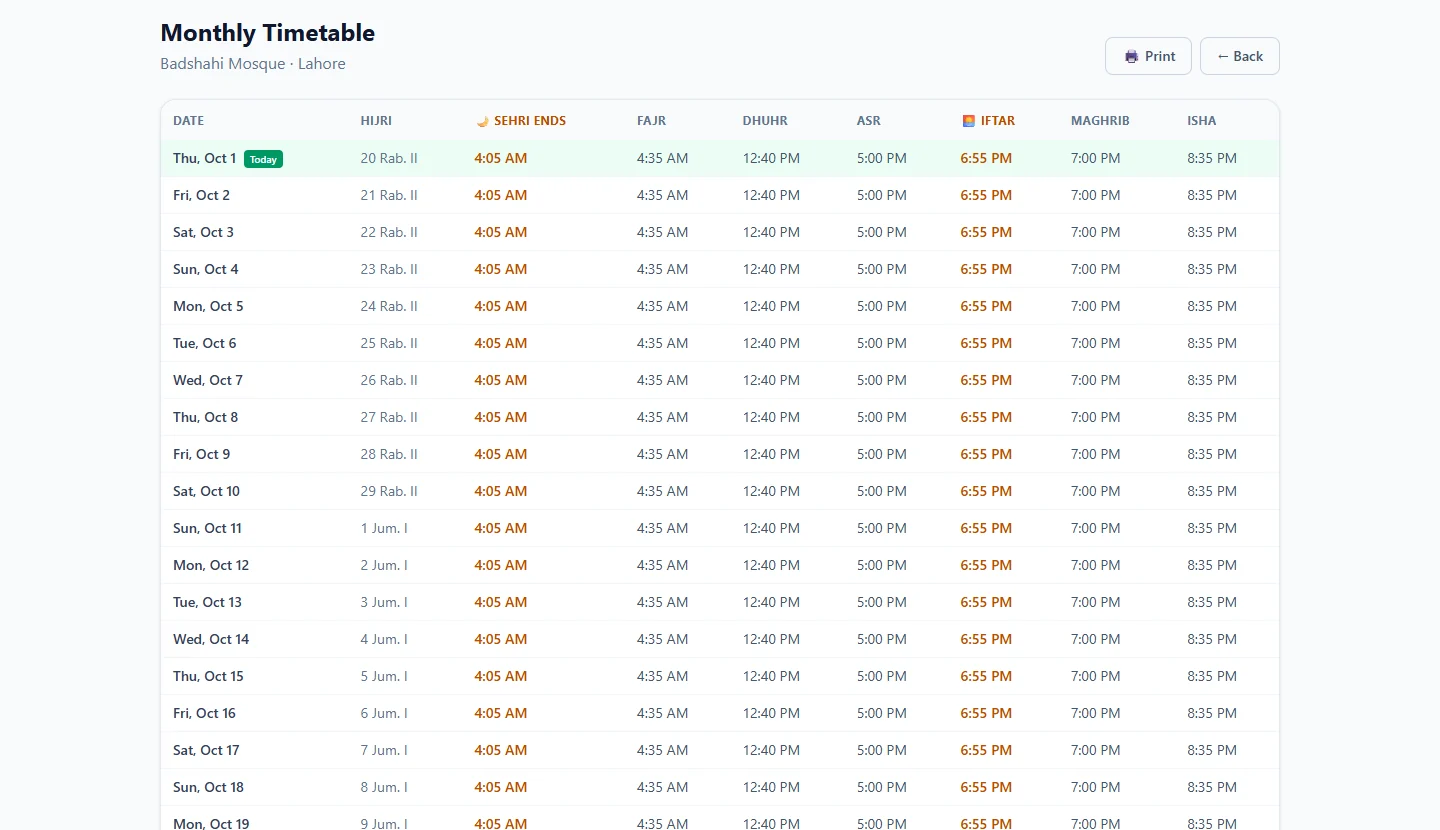
- Sehri ends and Iftar. Every mosque page with a timetable shows both. Unless the mosque sets them itself, Sehri ends is the Fajr Adhan minus the mosque's Imsak buffer (10 minutes by default), and Iftar is the Maghrib Adhan.
- Ramadan timetables. Many mosques switch to a special timetable for the month. While it is in force, the website shows Special timings in effect with its name, and the app, your reminders and the home-screen widget all follow it.
- A printable timetable. On a mosque's page, tap 🗓 Ramadan timetable for a day-by-day table with Hijri dates, Sehri, Iftar and the Iqaamah times, and a 🖨 Print button for the fridge.
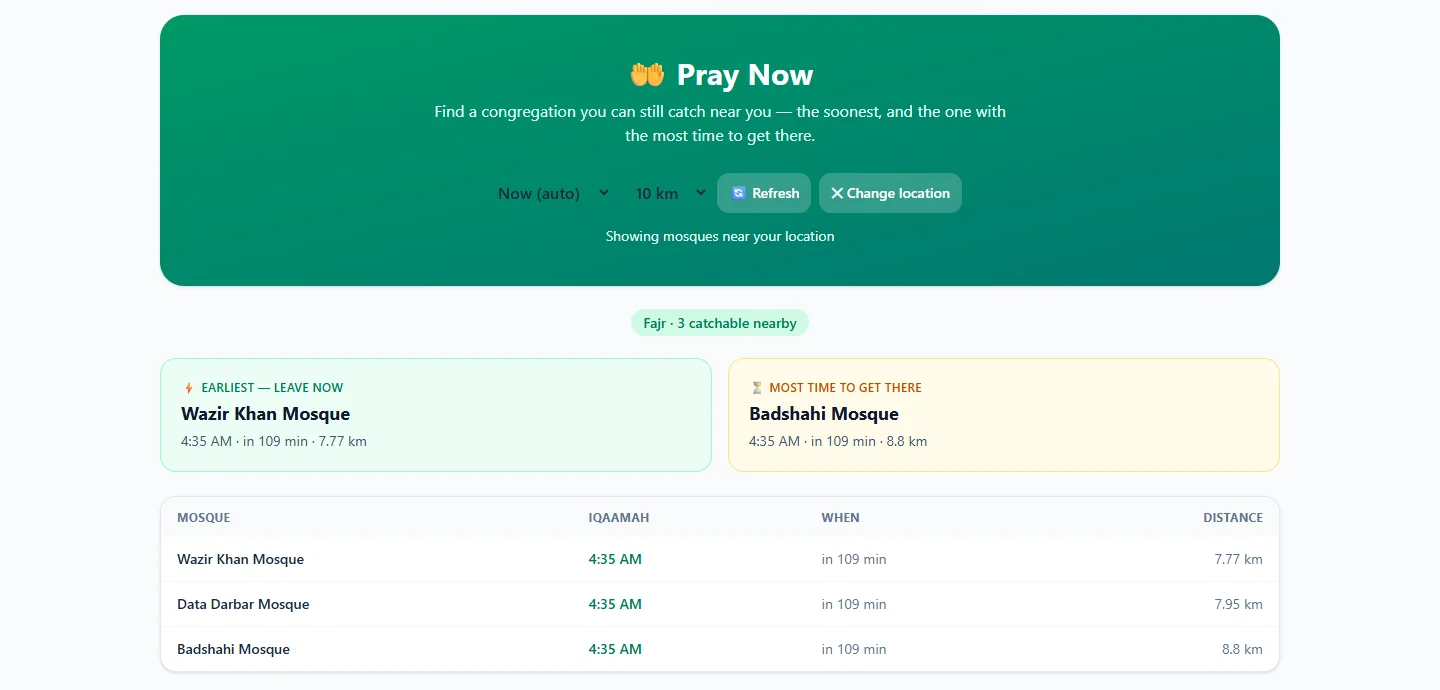
- Tarawih. During Ramadan, and in the weeks just before it, mosques can show their Tarawih start time, the number of rakʼahs, the reciter and tonight's juzʼ. The website's Pray Now page also lists Tarawih tonight at mosques near you.
- Eid. Eid prayer times appear on a mosque's page as the day approaches, with every jamaat and the venue.
- Reminders. Set a Fajr reminder at your mosque so you don't miss the prayer after suhoor, and a Maghrib one if you are out at iftar time. For suhoor itself, set an ordinary alarm well before the Sehri time. See Set up prayer reminders.
All of this is covered step by step in Find Jumuʼah, Ramadan, Tarawih and Eid prayer times.
Fasting while travelling
Most scholars hold that your fast follows the sun where you are: if you fly east or west during a fast day, you break your fast at sunset where you are, not at the time it would be at home. Islamic law also has concessions for travellers, with details that differ between schools, so check with a scholar before you rely on them.
Before a trip, open the mosques you'll need at your destination while you are still online, so their timetables are on your phone. Salah Locator shows every mosque's times in its own local time zone, so you don't have to convert anything. Praying on the go has more.
Long days far from the equator
In countries far from the equator, Ramadan in summer means very long fasts, and in some places the sky never becomes fully dark, which makes Fajr hard to calculate. Communities there follow timetables agreed by local scholars, using methods such as the timings of a nearer latitude. If that applies to you, follow your local mosque or council rather than an app's raw calculation.
A simple Ramadan routine
- Choose your mosque, and use its timetable for the whole month.
- Print its Ramadan timetable, or keep the mosque saved in the app.
- Set a reminder that leaves time to eat suhoor calmly before the Sehri time.
- Plan iftar around the Maghrib time, and allow for travel if you are breaking your fast at the mosque.
- Check the mosque's announcements for Tarawih, the khatm and Eid.
May your fasts be accepted.
Frequently asked questions
When does suhoor end?
The fast begins at true dawn, the start of Fajr. Many timetables print a Sehri or Imsak time a few minutes earlier as a precaution, and aiming to finish by then is the safest habit.
What is Imsak?
Imsak is a precautionary time, usually around ten minutes before Fajr, printed on many Ramadan timetables so people stop eating with a margin before dawn. Practice varies by community.
Should I break my fast at the Maghrib Adhan?
The fast ends at sunset, which is the start of Maghrib, so most people break their fast when the Maghrib Adhan is called. Some communities, including those following Jaʿfari practice, wait a little longer.
Why do two Ramadan timetables for the same city differ?
They may use different angles for Fajr, add different precautionary minutes, or be printed for a whole week rather than each day. Follow your local mosque's timetable.
Can I rely on a phone app's calculated times in Ramadan?
They are a reasonable guide, but calculations for Fajr differ between conventions by up to twenty minutes or more. Use your mosque's published timetable where there is one.
Was this post helpful?