How prayer times are calculated: Fajr angles, methods and Asr
Prayer times follow the sun where you are: Dhuhr after solar noon, Asr by shadow length, Maghrib at sunset, and Fajr and Isha at a set angle below the horizon.
On this page
Prayer times are worked out from the position of the sun at your exact location. Dhuhr begins just after the sun passes its highest point, Asr when shadows reach a set length, Maghrib at sunset, and Fajr and Isha when the sun is a particular angle below the horizon. Different scholarly bodies use different angles for Fajr and Isha and different rules for Asr, which is why two apps, or an app and your mosque, can disagree by several minutes.
This article explains those conventions. It describes how the calculations work; it doesn't rule on which one is correct. Where schools of thought differ, follow your local mosque or a scholar you trust.
The five prayers and the sun
| Prayer | When it begins, astronomically |
|---|---|
| Fajr | At true dawn, when the sun is a set angle (commonly between 15° and 19.5°) below the eastern horizon. It ends at sunrise. |
| Dhuhr | Just after solar noon, when the sun crosses the meridian and stands highest in the sky. |
| Asr | When the shadow of an object reaches a set length, which depends on the school (see below). |
| Maghrib | At sunset, when the top edge of the sun disappears below the horizon. |
| Isha | When the twilight has gone, at a set angle below the western horizon or a fixed time after Maghrib. |
Sunrise and sunset use an angle of about 0.833° below the horizon rather than zero. That small allowance covers the size of the sun's disc and the way the atmosphere bends its light, so the sun is really just below the horizon when it first appears.
Everything else is spherical astronomy. Given the date, your latitude and longitude and your time zone, the sun's declination (how far north or south of the equator it is) and the "equation of time" (how far the sun runs ahead of or behind the clock through the year) tell you exactly when it reaches each angle.
Why Fajr and Isha need an angle
Fajr and Isha are defined by light in the sky, not by the sun's disc. After sunset, twilight fades gradually; before sunrise, it builds gradually. Astronomers call the moment the sun is 18° below the horizon the end (or start) of astronomical twilight, after which the sky is fully dark.
Scholars and institutions have looked at when true dawn appears and when the evening twilight vanishes, and settled on different angles. The difference matters: in Lahore on 1 October 2026, a 15° Fajr falls at 4:50 AM, an 18° Fajr at 4:35 AM and a 19.5° Fajr at 4:28 AM. That's a 22-minute spread for the same sky, and it grows further from the equator.
(These and the other example times in this article are calculated with the same algorithm Salah Locator uses for its estimates, rounded to the minute. They illustrate the conventions; they aren't a timetable to pray by.)
The main calculation methods
| Method | Fajr | Isha | Commonly followed in |
|---|---|---|---|
| Muslim World League | 18° | 17° | Much of Europe and the Far East |
| ISNA (Islamic Society of North America) | 15° | 15° | North America |
| Egyptian General Authority of Survey | 19.5° | 17.5° | Egypt and parts of Africa and the Middle East |
| Umm al-Qura, Makkah | 18.5° | 90 minutes after Maghrib | The Arabian Peninsula |
| University of Islamic Sciences, Karachi | 18° | 18° | Pakistan, India, Bangladesh and Afghanistan |
| Institute of Geophysics, University of Tehran | 17.7° | 14° | Iran |
A few notes on these:
- The official Umm al-Qura calendar lengthens the Isha interval to 120 minutes during Ramadan.
- Isha differs too. In Lahore on the same date, ISNA's 15° gives Isha at 6:55 PM, the Muslim World League's 17° gives 7:04 PM, and Karachi's 18° gives 7:09 PM.
- The Tehran convention, following Jaʿfari practice, also sets Maghrib later than sunset, when the sun is about 4.5° below the horizon and the redness in the eastern sky has gone.
Asr: the standard and Hanafi rules
Asr is measured by shadows. At solar noon an upright stick casts its shortest shadow of the day; unless the sun is directly overhead, even that noon shadow has some length. After noon the shadow grows longer.
- The standard rule, held by the Shafiʿi, Maliki and Hanbali schools, starts Asr when the shadow equals the stick's own length plus its noon shadow.
- The Hanafi rule starts Asr when the shadow equals twice the stick's length plus its noon shadow.
The Hanafi Asr is therefore always later, and the gap changes with the seasons. Calculated for Lahore in 2026, the standard Asr on 21 December is at 2:45 PM and the Hanafi Asr at 3:26 PM, 41 minutes apart; on 1 October they are 3:15 PM and 4:07 PM; on 21 June, 3:44 PM and 5:01 PM, more than an hour apart. This is why an app set to one school can show an Asr time that looks wrong to someone who follows the other.
Maghrib and Dhuhr
These two are the least disputed. Maghrib is sunset (with the Jaʿfari exception above) and Dhuhr begins once the sun has passed the meridian. Many published timetables add a minute or two to Dhuhr, and sometimes to Maghrib, as a precaution (ihtiyat), so that nobody prays a moment too early.
High latitudes: when the night never gets dark
Far from the equator, the angle-based rules break down in summer. At about 48.5° latitude and above, around midsummer the sun never sinks 18° below the horizon, so astronomical twilight lasts all night. In London (51.5°N) on 21 June 2026, an 18° Fajr and a 17° Isha simply don't occur. Even a 15° calculation gives Isha at 12:49 AM and Fajr at 1:16 AM, 27 minutes apart.
Communities in these regions use adjustments such as dividing the night in half, using one-seventh of the night, scaling by the angle, or following the timetable of a nearer latitude, or they follow a timetable set by a local council of scholars. Salah Locator's estimates don't apply a special high-latitude rule, so if you live far north or south, rely on your mosque's published timetable.
Why your app and your mosque disagree
When a phone app and a mosque timetable differ, it is usually for one of these reasons:
- A different convention, for Fajr and Isha angles or for Asr.
- Precautionary minutes added by the mosque.
- A local agreed timetable, often drawn up by a council of mosques, sometimes based on local observation of dawn.
- Rounding, or a timetable printed for a month rather than each day.
- The Iqamah. The mosque's congregation time is chosen by the mosque and can't be calculated at all. See Adhan vs Iqamah.
How Salah Locator handles it
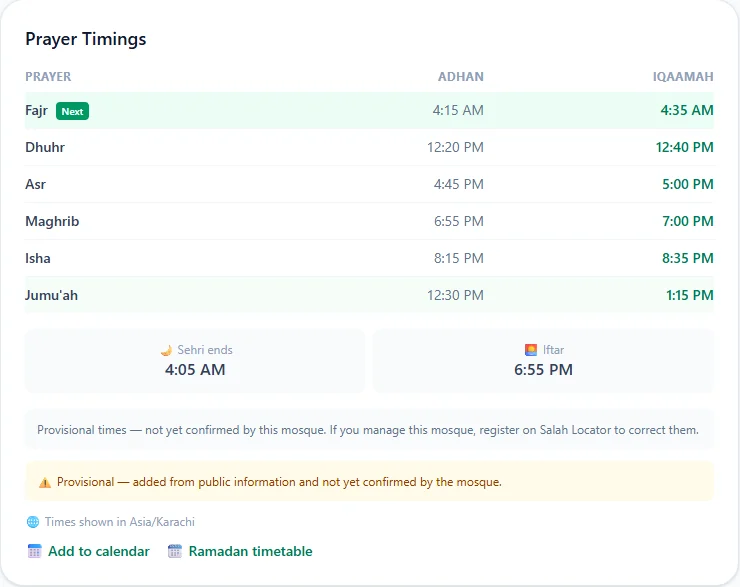
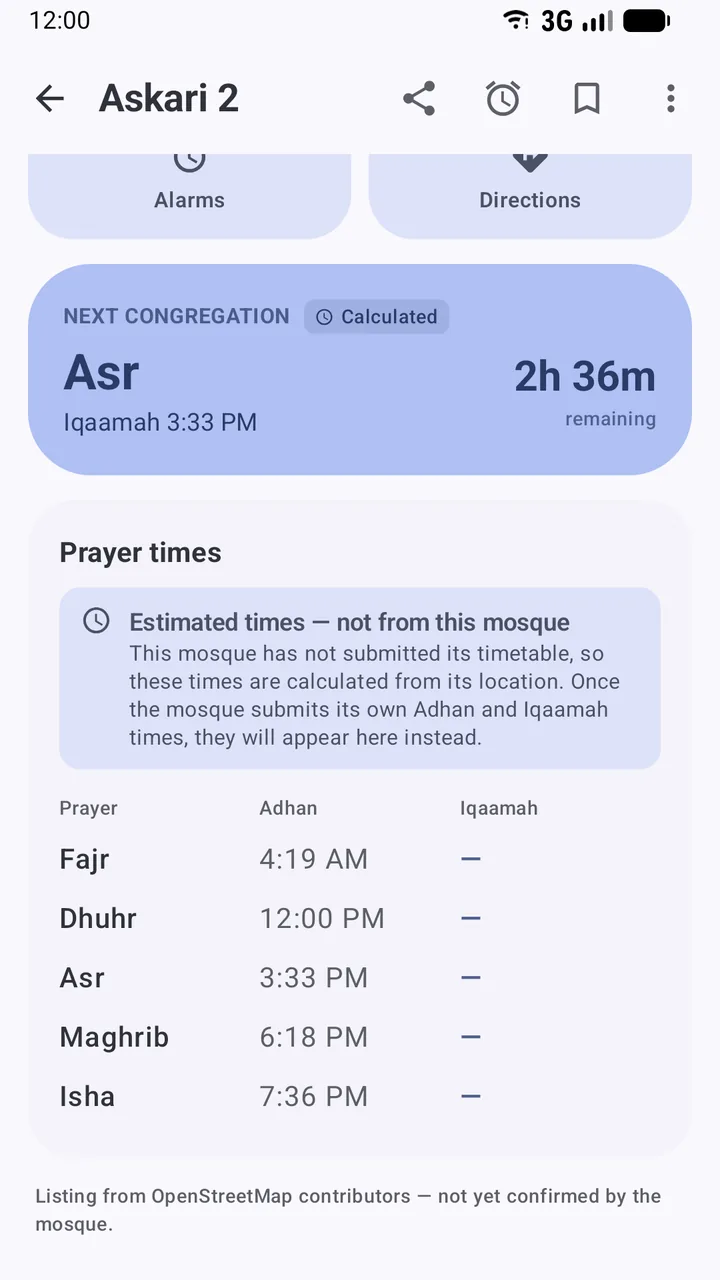
Salah Locator puts the mosque first. When a mosque publishes its own timetable, you see its Adhan and Iqaamah times exactly as it entered them, with a note saying where they came from. Only when a mosque hasn't published anything does the app calculate the Adhan times from the mosque's location, and it says so plainly with Estimated times — not from this mosque. It leaves the Iqaamah column empty rather than guess.
For those estimates you can choose the Calculation method and the Asr method (Standard (Shafi) or Hanafi) under Profile. The default is Muslim World League with the standard Asr. Changing it never alters a timetable a mosque has published. The steps are in Read a mosque's timetable.
The simplest advice is also the most reliable: find your mosque, and use its times. If your mosque isn't listed with a timetable yet, its committee can add one.
Frequently asked questions
Which prayer time calculation method should I use?
Use the one your local mosque or community follows. Muslim World League, ISNA, Egyptian, Umm al-Qura, Karachi and Tehran are all established conventions; they differ mainly in the Fajr and Isha angles. If you are unsure, ask your imam.
What is the difference between Hanafi and Shafiʿi Asr?
In the standard (Shafiʿi, Maliki and Hanbali) calculation, Asr begins when an object's shadow equals its length plus its shadow at noon. In the Hanafi calculation it begins when the shadow is twice the object's length plus the noon shadow, so Hanafi Asr is later.
Why is my app's Fajr time different from my mosque's?
The app and the mosque may use different Fajr angles, round differently or add a few precautionary minutes. Many mosques also follow a timetable agreed by a local council. Where they differ, follow your mosque.
What does the 18-degree rule mean?
It means Fajr begins, or Isha begins, when the sun is 18 degrees below the horizon. Other conventions use 15, 17, 17.5, 18.5 or 19.5 degrees, which is why their times differ.
What happens to Fajr and Isha in summer far from the equator?
Above roughly 48 degrees latitude, around midsummer the sun never sinks far enough for an 18-degree calculation to work, so there is no true night. Communities there use adjusted rules or a local council's timetable.
Was this post helpful?