Murattal, mujawwad and muallim: Quran recitation styles explained
Murattal is measured recitation at a steady pace; mujawwad is slower and more melodic, for listening gatherings; muallim is a teaching recitation for repeating after. All keep the same tajwid.
On this page
Murattal is measured recitation at a steady, moderate pace: clear, careful and close to how the Quran is recited in prayer. Mujawwad is slower and more melodic, with long phrases, pauses and repetition, made for listening gatherings and broadcasts. Muallim ("teacher") is a teaching recitation, slow and clear so that learners can repeat after it. All three keep the same rules of tajwid; they differ in pace, melody and purpose.
Tartil: the root of "murattal"
Murattal comes from tartil, as in the ayah وَرَتِّلِ الْقُرْآنَ تَرْتِيلًا (Al-Muzzammil 73:4), "and recite the Quran with measured recitation". Tartil means reciting slowly and distinctly, giving each letter its right. A definition attributed to Ali ibn Abi Talib describes it as tajwid of the letters and knowing where to stop.
So murattal isn't a fashion of a particular era: it is the measured, careful recitation the Quran itself asks for.
The three speeds of recitation
Scholars of tajwid describe recitation at different speeds, all of them correct as long as the rules are kept:
| Speed | Description | Typical use |
|---|---|---|
| Tahqiq | very slow and precise, every rule given its full measure | teaching and learning |
| Tadwir | a middle pace | everyday recitation |
| Hadr | quick, while keeping the rules | revision by huffaz, long prayers |
Some add tartil as its own speed between tahqiq and tadwir; others treat tartil as the quality that every correct recitation should have, at any speed.
Murattal
Most recordings you hear, and the recitation in most prayers, are murattal. Features:
- a steady, moderate pace;
- melody kept simple, serving clarity;
- usually one breath per phrase, with stops at natural places.
Murattal recordings are ideal for listening while you follow the mushaf, for memorising, and for checking your own recitation. Most of the reciters people know from radio and apps, such as Mishary Alafasy, Abdur-Rahman As-Sudais, Saud Al-Shuraim, Maher Al-Muaiqly and Saad Al-Ghamdi, are heard in murattal.
Mujawwad
Mujawwad comes from tajwid (from jawwada, to make excellent). In practice the word describes a slower, more elaborate recitation associated with Egypt's great reciters of the twentieth century, such as Mahmoud Khalil Al-Husary, Mohamed Siddiq El-Minshawi and Abdul Basit Abdus-Samad. Features:
- a slow pace, with very long breaths;
- melodic development, often moving through the melodic modes known as maqamat;
- repetition of a phrase or ayah, sometimes from different starting points;
- pauses between passages, traditionally for a listening audience.
Mujawwad is recited for listening and reflection, at gatherings, on the radio, at the opening of events. It is rarely used in prayer.
A note on melody
Beautifying the voice in recitation is encouraged; a hadith in Sunan Abi Dawud says "Beautify the Quran with your voices." At the same time, scholars caution that melody must never override the rules: a vowel stretched to fit a tune, or a madd cut short, is a mistake whatever its beauty. Views on deliberately learning and applying maqamat vary between scholars. If you're interested, ask a teacher you trust.
Muallim: the teaching recitation
A muallim recording is made for learners. The reciter recites slowly and very clearly, at the tahqiq end of the scale, so you can hear each letter and copy it. Al-Husary's teaching recitation is the best known. Use it when:
- you're learning to read and want to copy each sound;
- you're working on particular letters or rules;
- a child is memorising a short surah phrase by phrase.
Style is not the same as qira'ah
People sometimes confuse styles with qira'at. A qira'ah (reading) or riwayah (transmission) is a way of reciting the text itself that has been passed down with a chain of teachers. The ten recognised qira'at each have two main narrators, and they differ in some letters, vowels, word forms and rules.
- Hafs from Asim is the most widespread today, and is what most printed mushafs follow.
- Warsh from Nafi is common in North and West Africa.
- Others, such as Qalun and al-Duri, are recited in particular regions.
A murattal or mujawwad recitation can be in any riwayah. Reciters on most apps, including all 26 in Samee, recite Hafs from Asim.
Reciters in Samee, by style
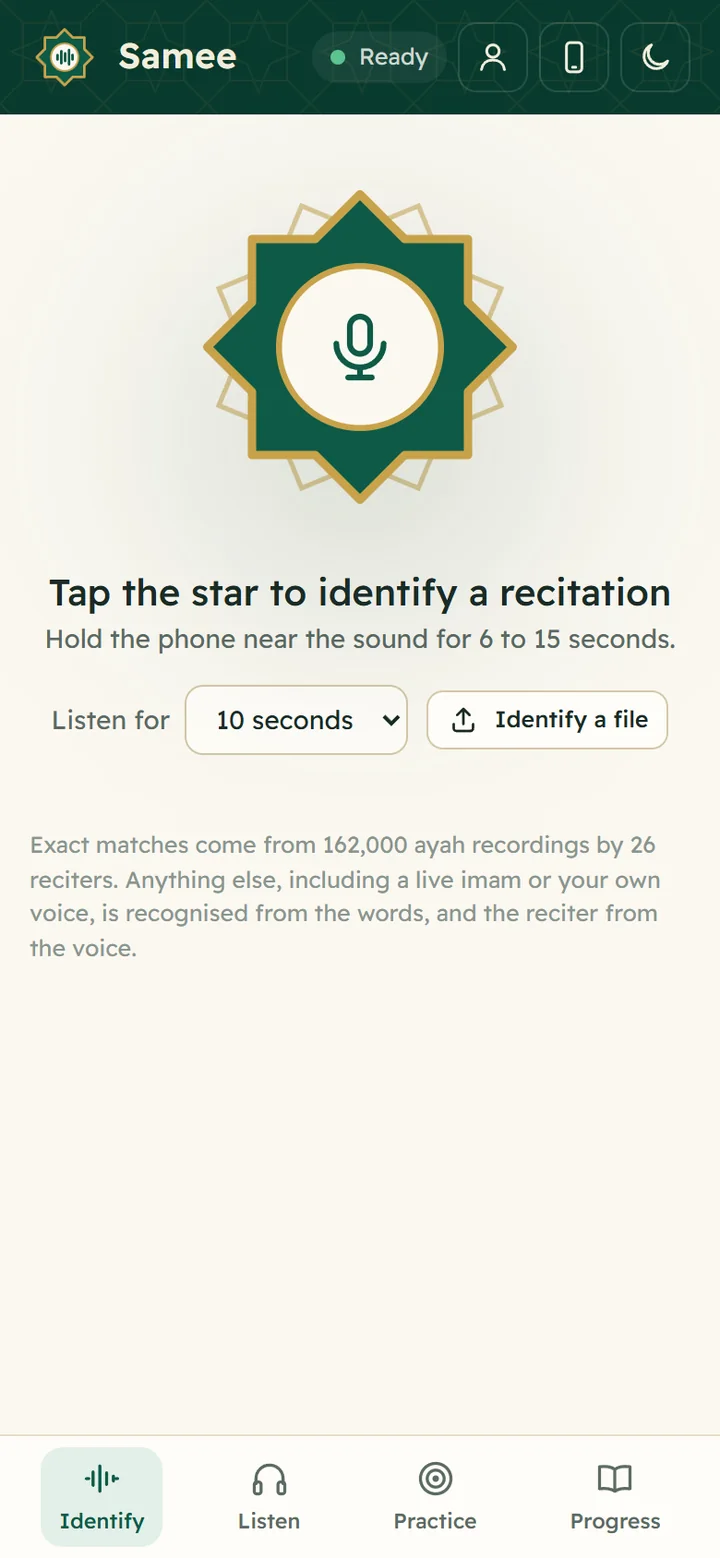
Samee identifies recitations against a catalogue of 26 reciters, and you can play any of them on repeat in Practice:
| Style | Reciters in Samee |
|---|---|
| Murattal | Mishary Rashid Alafasy, Abdur-Rahman As-Sudais, Abdul Basit Abdus-Samad (murattal), Mahmoud Khalil Al-Husary, Mohamed Siddiq El-Minshawi (murattal), Saud Al-Shuraim, Maher Al-Muaiqly, Saad Al-Ghamdi, Ali Al-Hudhaify, Abu Bakr Al-Shatri, Muhammad Ayyub, Hani Ar-Rifai, Yasser Ad-Dossary, Nasser Al-Qatami, Abdullah Basfar, Muhammad Jibreel, Fares Abbad, Ali Jaber, Salah Al-Budair, Khalid Al-Qahtani, Abdullah Awad Al-Juhany, Muhsin Al-Qasim, Ahmed ibn Ali Al-Ajamy |
| Mujawwad | Mahmoud Khalil Al-Husary, Mohamed Siddiq El-Minshawi |
| Teaching (muallim) | Mahmoud Khalil Al-Husary |
Each style of the same reciter is a separate set of recordings, so when Samee matches an exact recording it tells you which one you heard, for example Al-Husary's mujawwad rather than his murattal.
Which style should you listen to?
- Learning to read: a teaching (muallim) recitation, or a slow murattal such as Al-Husary or Al-Minshawi.
- Memorising: one clear murattal reciter, consistently. Changing reciters often makes it harder to settle the sound of a passage in your memory.
- Revising: a slightly faster murattal you can recite along with.
- Reflection: whatever moves you, mujawwad included.
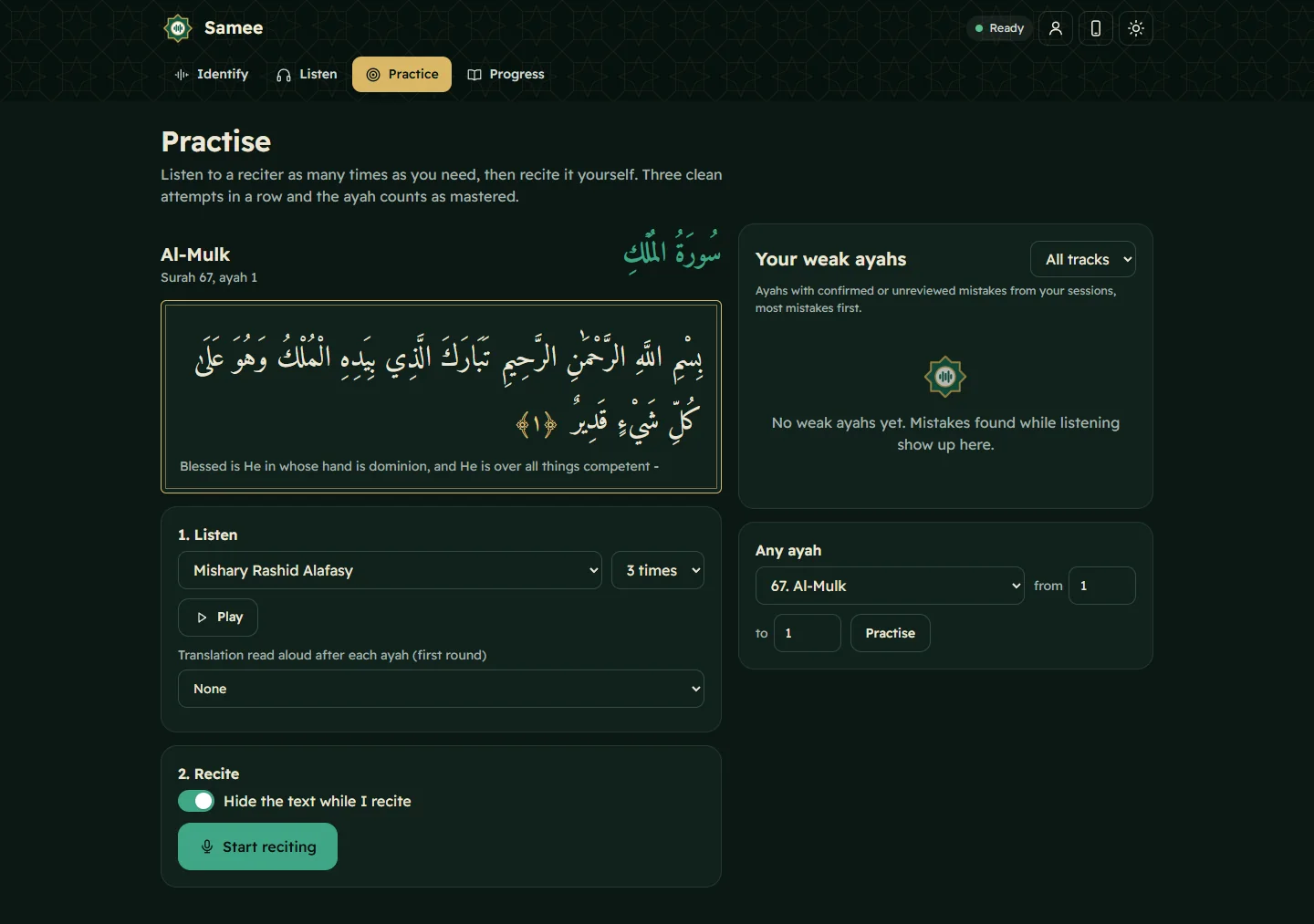
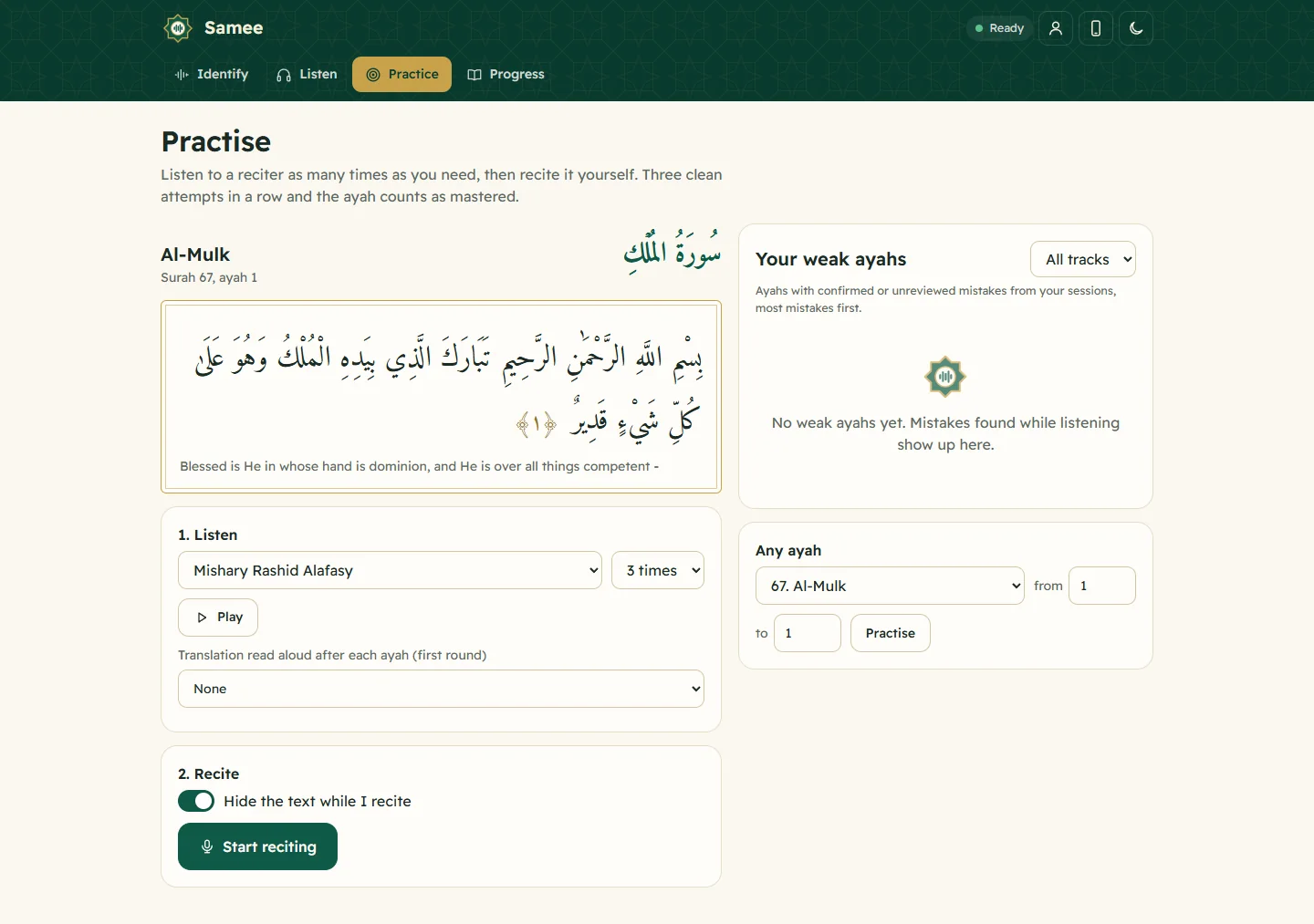
To drill a passage, open Practice, choose a reciter and 3, 5 or 7 times, then recite it yourself; see practise your weak ayahs. And if you heard a recitation and want to know who it was, identify it.
Frequently asked questions
What is the difference between murattal and mujawwad?
Murattal is recited at a steady, moderate pace with little melodic elaboration, as in prayer and most recordings. Mujawwad is slower and more melodic, with long pauses and repetition, made for listening gatherings. Both keep the rules of tajwid.
Which style is best for memorising the Quran?
A clear murattal recitation by one reciter, heard consistently, is what most memorisers use. Many beginners also use a teaching (muallim) recitation to get the pronunciation right.
Is a style the same as a qira'ah?
No. A style is about pace and melody. A qira'ah or riwayah is a transmitted way of reciting the text itself, such as Hafs from Asim or Warsh from Nafi, with small differences in letters, vowels and rules.
Is it allowed to recite the Quran melodically?
Beautifying the voice in recitation is encouraged in the hadith. Scholars caution against letting melody override the rules of tajwid, for example stretching vowels to fit a tune. Ask a teacher about specific practices.
Was this post helpful?