What is talqeen? Prompting a Quran reciter who gets stuck
Talqeen means having someone take words from you. In Quran learning it is teaching by recitation and repetition, and prompting a reciter who stops with the next words; in prayer, prompting the imam.
On this page
Talqeen (تلقين) means helping someone take words from you. In Quran learning the word has two everyday uses. It is the way the Quran has always been taught, with the teacher reciting and the student repeating. And it is prompting: giving a reciter the next words when they stop or go wrong, whether a student in a class or an imam in prayer. A third, separate use is the talqeen of a dying person, reminding them of the shahada.
The word
The root l-q-n carries the sense of grasping something quickly. Laqina means to understand or take in; laqqana, the verb behind talqeen, means to make someone take in, to dictate or prompt. The student's side of the same act is talaqqi, receiving. When people speak of learning the Quran "by talaqqi", they mean receiving it orally from a teacher who received it the same way.
Talqeen as teaching
The Quran was first transmitted by recitation, ear to ear. A report in Sahih al-Bukhari describes the Angel Jibril reviewing the Quran with the Prophet ﷺ every Ramadan, and twice in his final year. The Companions learned from the Prophet ﷺ in the same way, and taught those after them.
That chain of oral transmission is still how recitation is taught:
- The teacher recites a short portion, clearly and slowly.
- The student repeats it, imitating the sounds exactly.
- The teacher corrects, recites again, and the student repeats until it is right.
- Later, the student recites the portion alone, and the teacher listens.
A student who completes the whole Quran this way with a qualified teacher may receive an ijazah, a permission to recite and teach with a chain of teachers going back to the Prophet ﷺ.
Talqeen in this sense is why recordings of a slow, clear reciter are so useful to learners: they let you repeat after a model voice between lessons. They don't replace the teacher, who hears what you do wrong.
Talqeen as prompting
The second meaning is the one most people mean in a hifz class: the student stops, and the teacher or a classmate gives the next words.
Prompting a student
Good prompting helps memory rather than replacing it.
- Wait first. A few seconds of silence often brings the words back, and recalling them yourself fixes them better than hearing them.
- Give the minimum. Often the first word, or the first two, is enough. The student finishes the ayah.
- Watch for the pattern. A student who stops at the same place every time has a weak link there, often at the start of an ayah, a page turn or a passage that resembles another. Mark it for revision.
- Count the prompts. For a hifz test, a passage that needed a prompt isn't yet secure, even if it was otherwise perfect.
Prompting the imam
In congregational prayer, especially Taraweeh, the imam recites from memory and may stop or make a mistake. A follower then recites the correct words aloud so the imam can continue. This is called al-fath 'ala al-imam, "opening for the imam". It has been practised since the earliest generations; collections such as Sunan Abi Dawud have chapters on it, and the schools of fiqh discuss the details, such as when to prompt and whether to wait first.
In many mosques a hafiz stands behind the imam for exactly this role, and the congregation leaves the prompting to him. We cover the practice, and the related question of holding a mushaf, in following Taraweeh.
Talqeen of the dying
In another context, talqeen refers to gently reminding a dying person to say la ilaha illa Allah, following a hadith in Sahih Muslim: "Prompt your dying with la ilaha illa Allah." Some also speak of a talqeen at the grave after burial; scholars differ on that practice. This meaning has nothing to do with recitation, but it's why the word appears in very different searches.
Digital talqeen: when an app prompts
A phone that follows the recitation knows where the reciter is, so it can show the next words when they stop. Samee does this in two places:
- On Listen, with Show the next words when the reciter gets stuck, after switched on. After 3, 5 or 8 seconds of silence in the middle of an ayah (your choice), a card shows the next few words, labelled Next words and the ayah. During a hifz test it also prompts at the end of an ayah, after twice the time, labelled Next ayah.
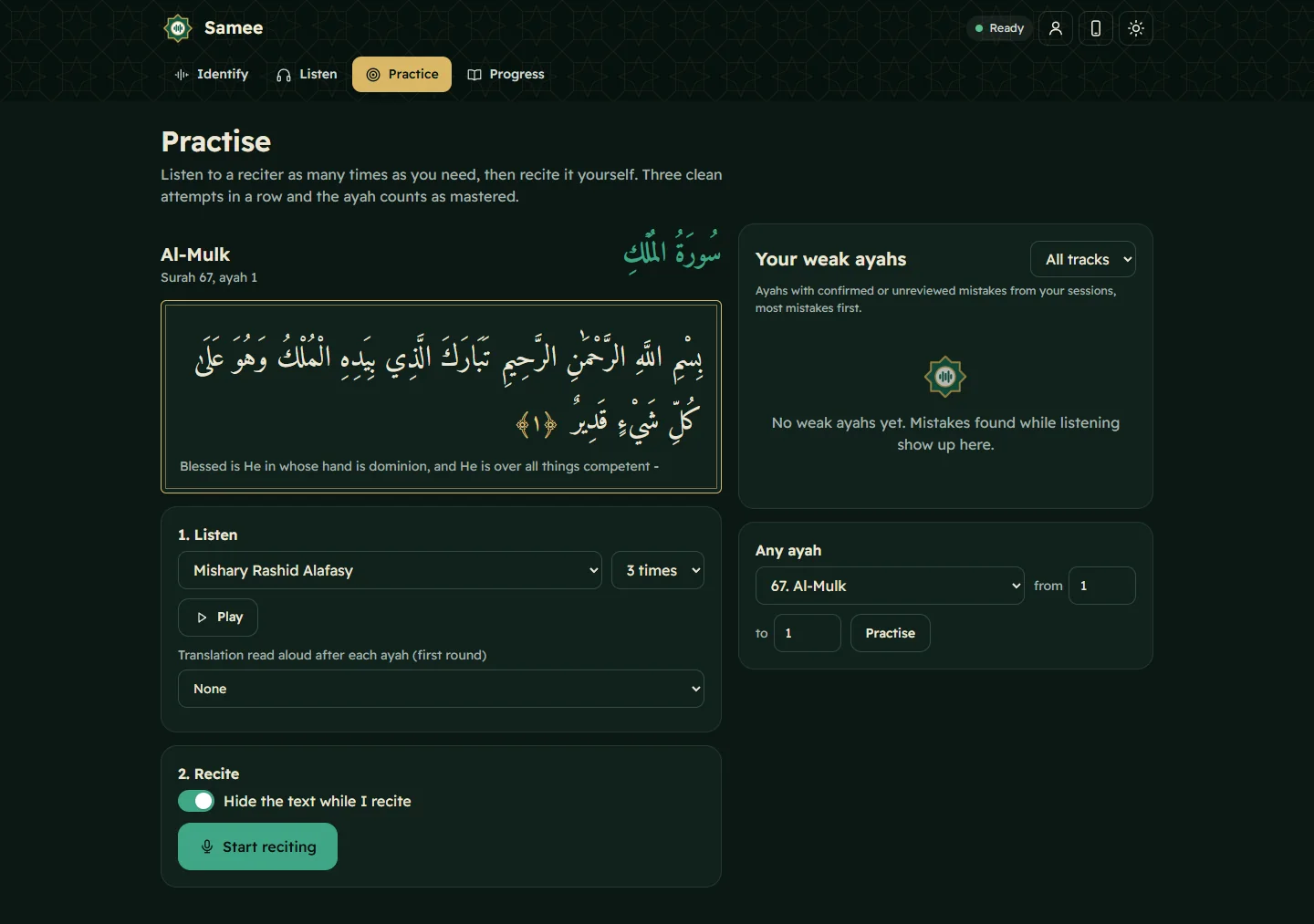
- On Practice, when you recite with the text hidden: after about 4 seconds, A hint: the next words.
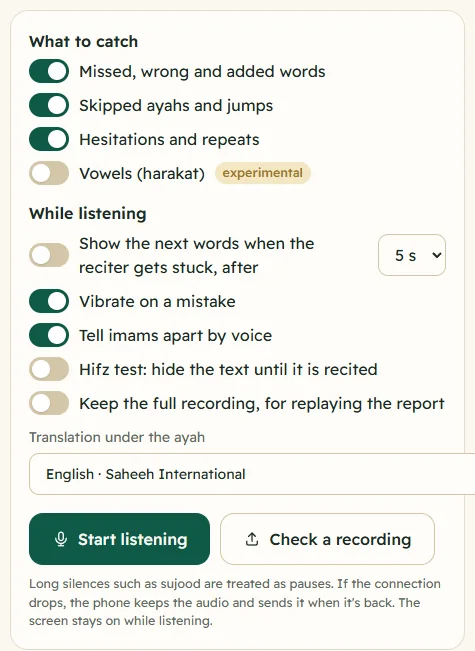
The card is silent. The phone vibrates where that's allowed, but nothing is said aloud, so it suits:
- a student revising alone, who glances at the card instead of opening the mushaf;
- a teacher following a student's recitation;
- someone following the imam who isn't in the prayer, such as a teacher at the back or a person listening to a live stream, and wants to prompt correctly.
In ordinary listening, Samee doesn't prompt between ayahs, so ruku and sujood don't produce cards. The full behaviour is in talqeen in Samee.
Use it the way a good teacher would
The same rules apply to a screen as to a teacher:
- Choose the longest wait you can bear (8 s), so you try to recall first.
- Treat every prompt as a note for revision. Samee records a Hesitated note where you stopped mid-ayah, so the places show up in the report.
- Revise the prompted ayahs until you no longer need the card: Samee's hifz test marks an ayah mastered after three clean attempts in a row.
In short
Talqeen is the teacher giving and the student taking, whether that's a whole lesson repeated phrase by phrase or a single word at the moment of forgetting. Done well, it builds memory rather than replacing it.
Frequently asked questions
What does talqeen mean?
Talqeen (تلقين) comes from a root meaning to take in or receive quickly. It means helping someone take words from you: teaching the Quran by reciting so the student repeats, prompting a reciter with the next words, and, in another context, gently reminding a dying person of the shahada.
What is the difference between talqeen and talaqqi?
They are two sides of the same exchange. Talqeen is what the teacher does, giving the words; talaqqi is what the student does, receiving them directly from the teacher's mouth.
How should a teacher prompt a student who is stuck?
Wait a few seconds so the student can try to recall, then give as little as possible, often just the first word or two. Note the place, because it needs revision.
What is prompting the imam called?
Al-fath 'ala al-imam, literally opening for the imam. A follower, usually a hafiz behind him, recites the right words so the imam can continue.
Was this post helpful?