Shade cards and colour naming systems in textiles
A shade card is a set of colour samples used to specify colour. Names like "olive" are ambiguous; systems such as Munsell, ISCC-NBS and CIELAB tie a name or code to a position.
On this page
A shade card is a set of colour samples used to choose, specify and communicate colours. A naming system attaches a name or code to each colour. Everyday names like olive or rust are ambiguous – two people rarely mean exactly the same colour. Systems such as Munsell, ISCC-NBS and CIELAB give each colour a defined position, so a name or code points to one region of colour space. For dyeing, the safest specification is a physical standard plus measured values, the lights to judge under and a tolerance.
Kinds of shade cards in textiles
- Dye makers' shade cards show each dye (and often standard mixtures) dyed at set depths on a stated fabric. They tell you what a dye can do, not what your customer wants.
- Mill and dye-house cards collect the shades a unit has dyed before, with their recipes. They are a company's memory.
- Buyer and brand standards are the physical swatches, often with measured data, that a production shade must match.
- Commercial colour systems sell books of textile swatches with codes, widely used by designers and brands to choose and order colours.
A card is only as reliable as its physical condition. Swatches fade, get handled and yellow with age, so standards are stored dark and cool and reissued periodically.
Reading a dye maker's card
A dye maker's card usually shows each dye at a ladder of depths – for example from well under 1% up to several percent owf – on a named, prepared fabric, often with fastness ratings beside it. Read it to answer practical questions:
- How strong is this dye? Compare how deep each dye looks at the same % owf.
- How does it build? Some dyes keep getting deeper as you add more; others level off.
- Which dyes belong together? Makers often group dyes that are recommended as a compatible set.
What the card cannot tell you is how the dye will look on your fabric, prepared your way, in your water. That is still a job for a lab dip.
Why descriptive names fail
"Olive", "sage", "khaki" and "moss" overlap. One buyer's navy is another's midnight. Names also change with fashion and language. A name is useful as a label on a card – "the olive for the autumn range" – but it cannot carry the colour by itself.
Systems that give colours an address
Munsell
The Munsell system describes colour by three perceptual attributes: hue (which colour family), value (how light) and chroma (how strong). Its notation, such as 5Y 5/6, names a position, and its physical atlas shows samples at regular visual steps. It remains a foundation for how colour is taught and organised.
ISCC-NBS names
The ISCC-NBS system, developed by the Inter-Society Color Council and the US National Bureau of Standards, divides colour space into 267 blocks, each with a standard name built from a small vocabulary: moderate olive, dark grayish blue, strong reddish orange. The names are systematic, so they carry meaning – "grayish" and "dark" always mean the same direction – and because the system was published as a US government document, it is free to use.
CIELAB coordinates
CIELAB gives every colour three numbers: L* (lightness), a* (green–red) and b* (blue–yellow). It is the language of measurement and of colour-difference formulas such as ΔE2000. It is precise but not friendly to read aloud, which is why numbers and names are used together. See CIELAB and Delta E (ΔE2000) explained for dyers.
Specifying a textile shade clearly
A good colour specification has:
- A physical standard (or a digital spectral standard) – the reference everyone judges against.
- Measured values with the conditions: illuminant, observer, instrument geometry.
- A tolerance and the formula it is expressed in.
- The lights for visual approval.
- A name or code – as a label, not the definition.
How Shadecard names its shades
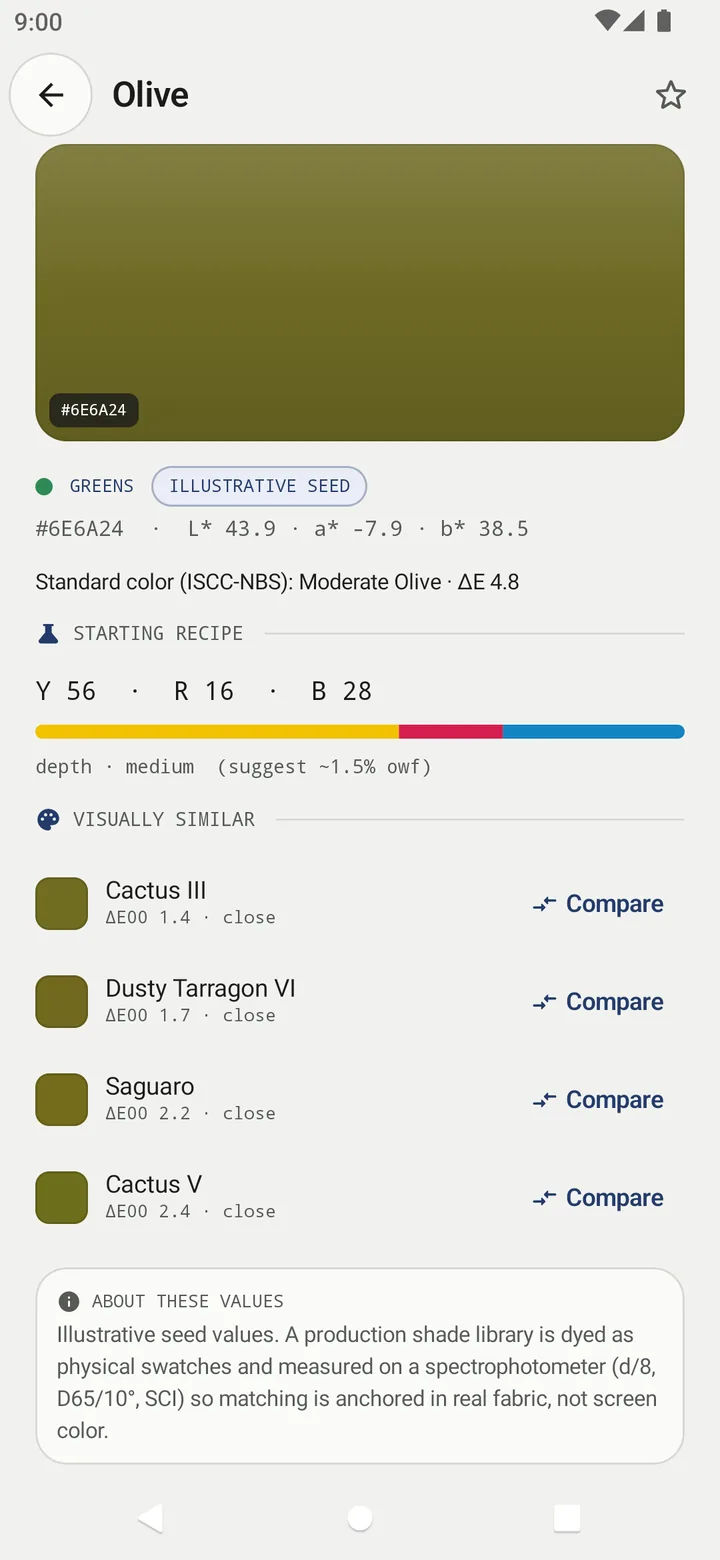
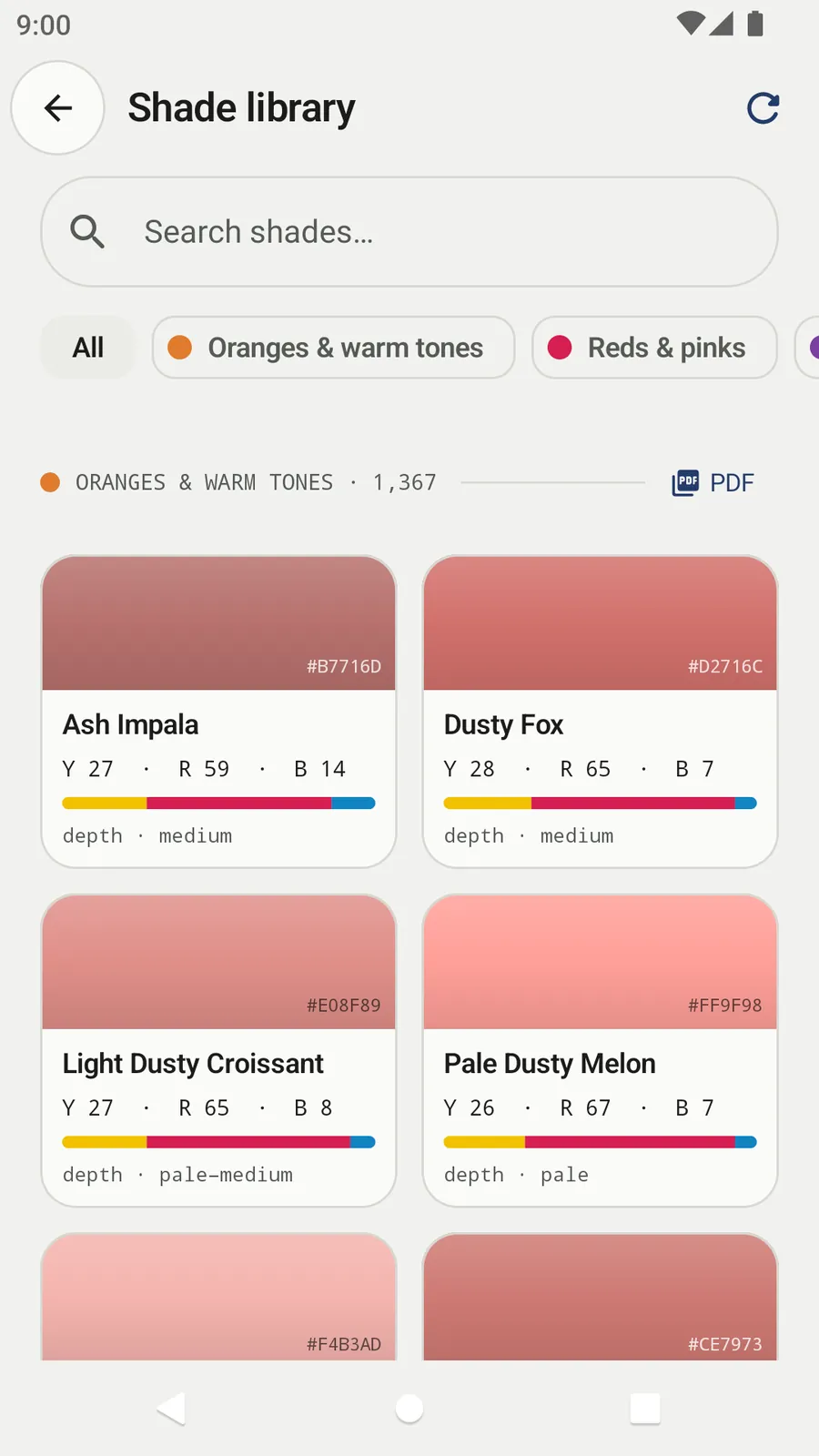
Shadecard's library has 13,297 named shades in six families. Names are descriptive labels – Dusty Fox, Ash Impala, Olive – and neighbouring shades can share a root with a number, such as Cactus III and Cactus V. Each shade also carries its hex, L*a*b*, a Y:R:B ratio and a typical depth, so the name is never the only information.
To tie the library to a public standard, every shade page shows its nearest ISCC-NBS designation and the distance to it, for example Standard color (ISCC-NBS): Moderate Olive · ΔE 4.8. That gives a systematic, shareable name next to the library's own.
Each family in the library can be exported as a PDF shade card: A4 pages, 72 swatches each, with name and hex, and the family's most common ISCC-NBS designation on the first page. It is useful as a printable index or to send on WhatsApp.
Your own shade card
The most valuable shade card in a dye house is its own: shades it has actually dyed, with the recipes that worked. In Shadecard, an approved lab-dip recipe can be promoted to a custom shade, badged user shade, which then joins matching like any library shade. See From Shadecard recipe to lab dip.
Key points
- Shade cards communicate colour; their physical condition matters.
- Descriptive names are labels, not specifications.
- Munsell, ISCC-NBS and CIELAB give colours defined positions.
- Specify with a standard, measured values, lights and a tolerance.
Related: What is trichromatic dyeing?
Frequently asked questions
What is a shade card in textiles?
A set of colour samples used to choose or specify colours. Dye makers publish cards of their dyes at standard depths, mills keep cards of their own recipes, and buyers issue colour standards.
What is the ISCC-NBS colour system?
A naming system from the Inter-Society Color Council and the US National Bureau of Standards that divides colour space into 267 named blocks, such as 'moderate olive' or 'dark grayish blue'. It is published as a US government document.
Is a colour name enough to order a shade?
No. Names are labels; people and companies use them differently. Specify a physical standard or measured values, with the illuminant, observer and tolerance.
Can I print a shade card from Shadecard?
Yes. Each family in the Shade library has a PDF button that builds an A4 card with swatch, name and hex. Treat printed swatches as a reference list, not as dyed standards.
Was this post helpful?