How to match a fabric colour with your phone camera
A phone can get you close to a fabric's colour if you control the light, put a known reference (white paper or a grey card) in the frame, average several shots and lab dip.
On this page
You can match a fabric colour with a phone camera, but not by snapping a photo and picking a pixel. To get a usable reading you need four things: steady, soft light, a reference of known colour in the frame (plain white paper or an 18% grey card), several photos averaged over a plain area, and a lab dip at the end to confirm the recipe. Shadecard builds those steps into one tap, but the principles apply however you work.
Why a plain photo lies about colour
A phone does not record colour; it interprets it. Before you see the image, the camera has:
- Guessed the light (auto white balance) and tinted the whole picture to "correct" it.
- Chosen an exposure and applied a tone curve that brightens shadows and compresses highlights.
- Sharpened and smoothed the image.
Take two photos of the same cloth a minute apart, or with a white wall in one of them, and the numbers change. A colour picker on one pixel adds its own error: weave texture, a glint of sheen or the shadow between yarns can all sit under that single pixel.
Step 1: Control the light
Colour depends on the light it is seen in. For measuring:
- Work near a window with indirect daylight, out of direct sun.
- Switch off room lamps so there is only one kind of light.
- Keep away from coloured walls, signs and screens that throw coloured light onto the cloth.
- Avoid flickering tube lights and cheap LEDs if you can; they can stripe the image.
Direct sun is not better light for this. It creates hard shadows and glare that wash out part of the fabric.
Step 2: Put a known colour in the frame
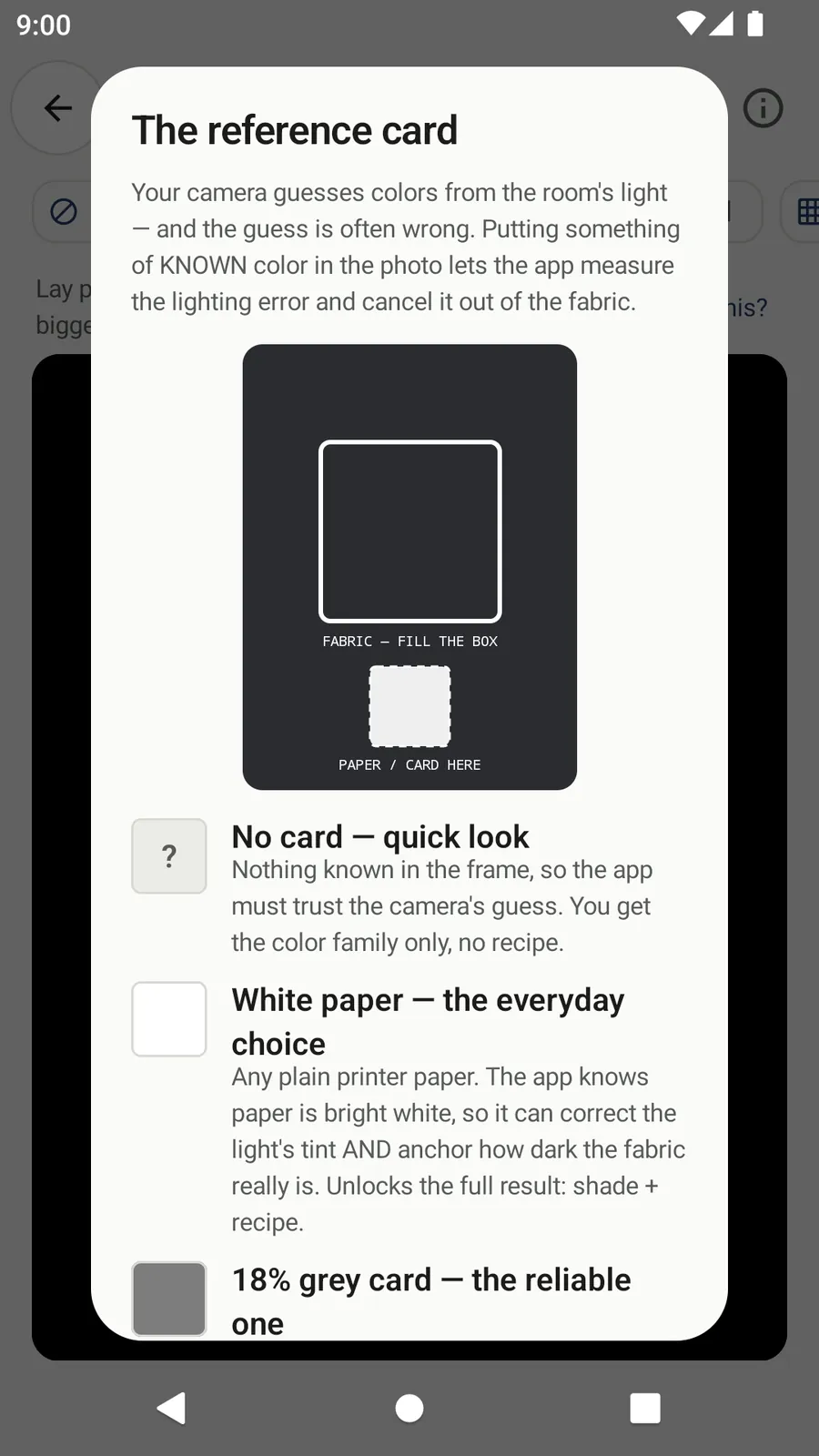
This is the single most important step. If a sheet of plain white paper sits next to the fabric, in the same light, you know what "white" should look like. Any tint the paper shows is the light's (or the camera's) doing, and can be divided out of the fabric too. The paper also fixes the brightness scale, so a dark cloth is not reported lighter than it is.
- White printer paper – everyday choice; use plain, matt, bright white.
- 18% grey card – the photographer's standard; made to be neutral, and less likely to overexpose.
- 24-patch colour chart – corrects tint, exposure and hue errors at once.
More detail: Grey card vs white paper for colour correction.
Step 3: Frame a plain area and hold still
- Lay the fabric flat, with no folds, seams or print in the measured area.
- Hold the phone about 15 cm away and tilted 30–45°, so the lens does not see its own reflection in the cloth.
- Keep the reference touching the fabric and in exactly the same light.
Step 4: Measure, don't eyeball
A good reading averages the whole plain area, ignoring the very brightest and darkest pixels (glints and inter-yarn shadows), and it does this in linear light, not on the gamma-encoded pixel values. Taking three photos with exposure and white balance locked gives two benefits: noise averages out, and if the photos disagree you know something moved.
The result should be a colour in CIELAB (L*, a*, b*), because that is the space shade libraries and ΔE colour-difference formulas use.
Step 5: Find the nearest shade and a starting recipe
Once you have L*a*b*, compare it with a library of shades that carry recipes, using ΔE2000. The nearest shade gives you a yellow:red:blue ratio (the hue), and the fabric's own lightness tells you roughly how much dye to use (% owf). Pick the dye class from the fibre on the care label.
How Shadecard does these steps
Shadecard is an Android app built around exactly this protocol:
- You choose White paper, 18% grey card or Color chart and place it in the small box on screen.
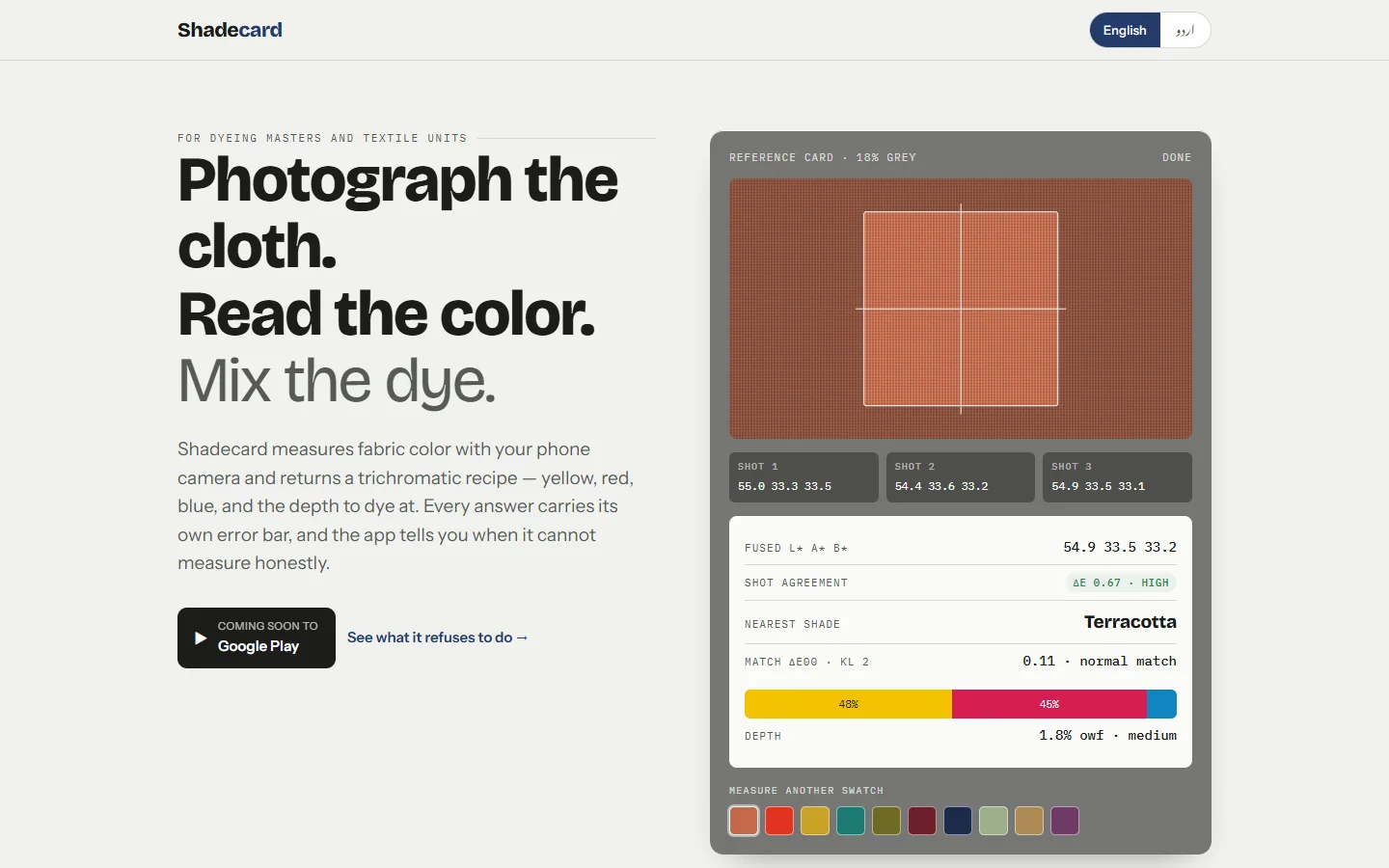
- One tap on the shutter meters, locks exposure and white balance, and takes three photos.
- The app corrects each photo against the reference, averages the fabric box and fuses the three into one L*a*b* reading.
- It reports the spread between the photos as an error bar and refuses the capture if they disagree by more than ΔE 3, or if glare or an overexposed card spoils it.
- It matches the reading against 13,297 shades using ΔE2000 and shows the nearest shade, two runners-up, a Y:R:B Starting recipe and a depth.
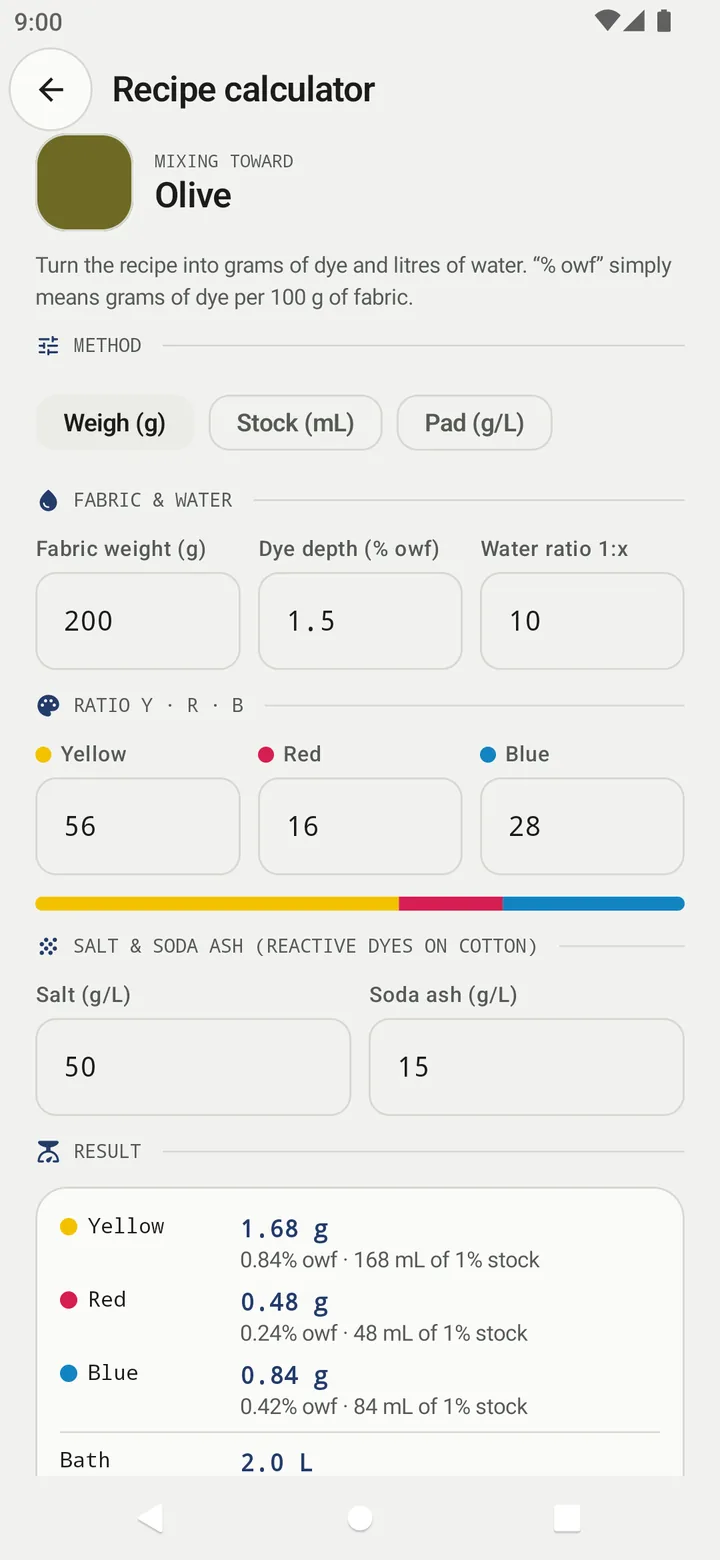
- Work out the amounts turns the recipe into grams, mL of stock solution or g/L of pad liquor.
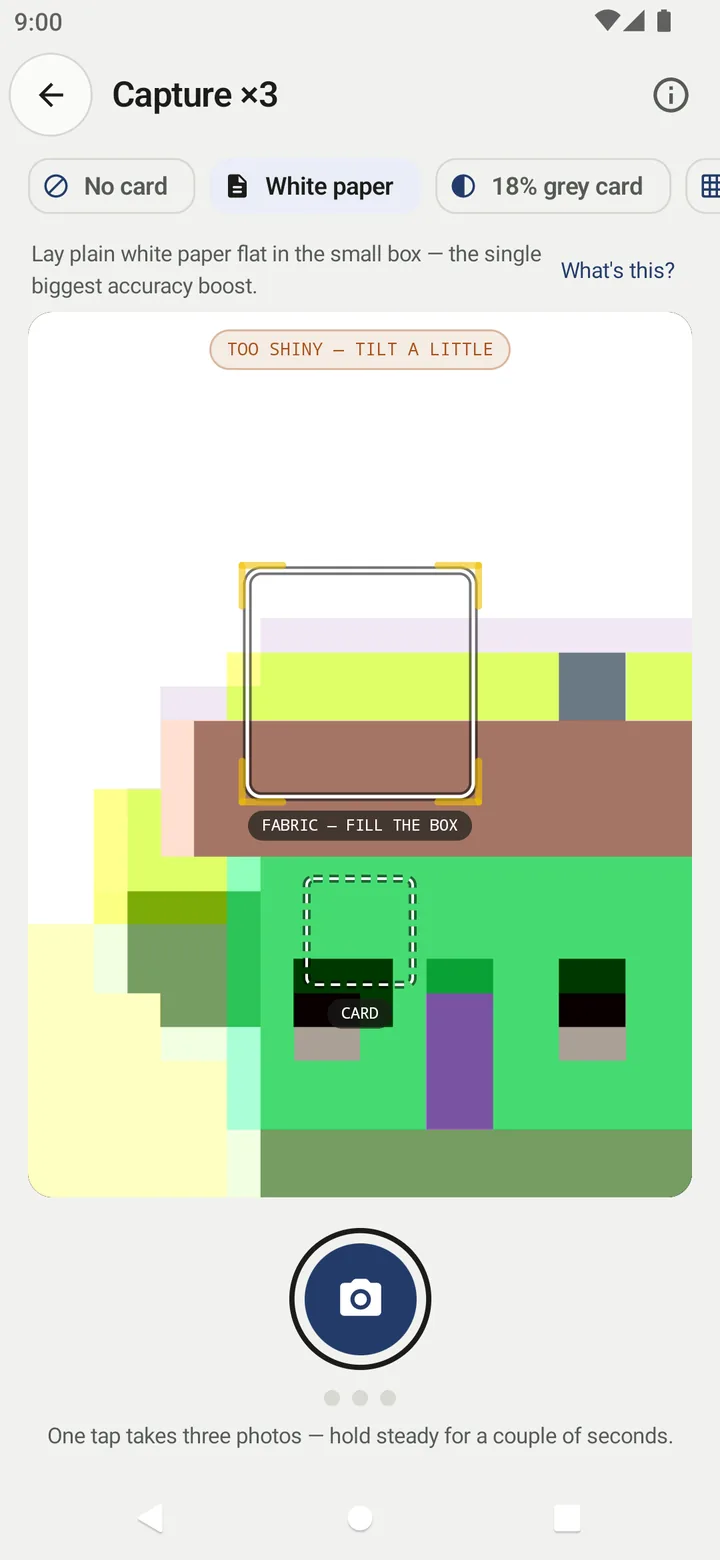
Without a reference card it names only the colour family – no recipe – because the camera's colour guess is unverified. Step-by-step with screenshots: Take your first fabric reading.
What a phone cannot do
Be clear about the limits before you promise a customer anything:
- It is not a spectrophotometer. It sees three colour channels, not a reflectance spectrum, so it cannot detect metamerism or compute exact dye concentrations.
- Phones differ. Two models can read the same cloth differently even after correction. Measure a target and its dips on one phone. See Why two phones read the same fabric differently.
- Some fabrics are out of scope. Optically brightened whites and fluorescent colours break the method; strongly lustrous or printed fabrics need extra care.
- The recipe is a hypothesis. The first recipe from any method – phone, eye or software – is proved on a lab dip.
Checklist
| Do | Avoid |
|---|---|
| Indirect daylight, one source | Direct sun, mixed lamps, coloured light |
| White paper or grey card beside the cloth, same light | No reference; card in shadow |
| Flat, plain area filling the frame | Folds, seams, prints |
| Phone tilted 30–45°, held still | Straight-on shots that catch glare |
| Several shots, averaged and compared | One photo, one pixel |
| Lab dip before bulk | Dyeing bulk from the first recipe |
Done carefully, a phone turns "make this colour" into a measured starting point, a named shade and a first recipe in a minute – and the lab dip does the rest. Read on: The lab dip process explained.
Frequently asked questions
Can I just use a colour picker on a photo of the fabric?
It will give a number, but not a reliable one. The phone's automatic white balance and exposure change the colour from photo to photo, and a single pixel picks up texture and glare. Correct with a reference and average the whole area.
What is the best light for photographing fabric colour?
Soft, indirect daylight near a window, with other lamps off and no direct sun. One light source, no shadows across the cloth.
Is white paper good enough as a reference?
Yes, for everyday matching. Plain white printer paper lets you correct the light's tint and the brightness. A photographic 18% grey card is more consistent.
How close can a phone get?
Close enough to name the shade family and choose a sensible first recipe, when the capture is controlled. It is not a spectrophotometer, so the final match is always judged on a lab dip.
Was this post helpful?