Use the recipe calculator: grams, stock solution or pad liquor
In short
Enter fabric weight, depth (% owf), water ratio and the Y:R:B ratio. Pick Weigh (g), Stock (mL) or Pad (g/L); the calculator gives each dye plus bath volume, salt and soda.
On this page
The Recipe calculator turns a recipe into amounts you can weigh or pipette. Enter the Fabric weight (g), Dye depth (% owf) and Water ratio 1:x, check the Ratio Y · R · B, and read the Result: grams of each dye (or mL of stock, or g/L of pad liquor), the bath volume, and the salt and soda ash for a reactive bath. It never uses a scan.
Open the calculator
There are three ways in:
- From a result: tap Work out the amounts. The shade, ratio and recommended depth are filled in.
- From a shade page: tap Open in recipe calculator.
- From the home screen: tap Recipe calculator. It opens with Rust (example): Y 52 · R 43 · B 5 at 2.0% owf.
The header shows the colour you are MIXING TOWARD, so the numbers are never detached from the shade.
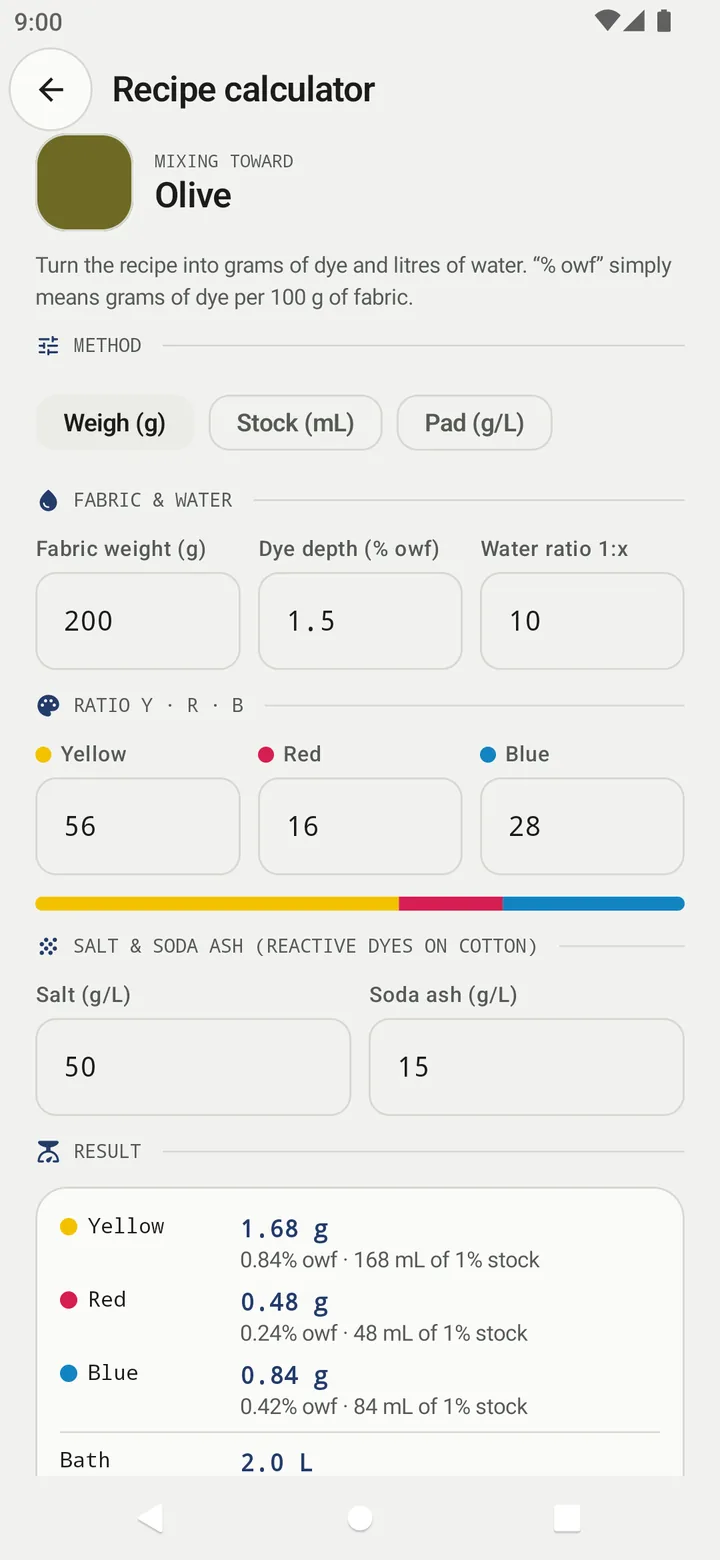
Fill in the fields
- Fabric weight (g) – dry weight of the cloth. Starts at 200.
- Dye depth (% owf) – total dye as a percentage of fabric weight.
- Water ratio 1:x – litres of bath per kg of fabric. 10 means 1:10. Starts at 10.
- Ratio Y · R · B – the three parts. If they do not add up to 100, the calculator notes ratio sums to … — normalized automatically.
- Salt (g/L) and Soda ash (g/L) – dosing per litre of bath. Start at 50 and 15.
Decimals can be typed with a point or a comma (1.5 or 1,5).
Method 1: Weigh (g)
For bulk batches where you weigh each dye. For every dye the result shows grams, its own % owf and the equivalent mL of 1% stock, then Bath (fabric kg × liquor ratio), Salt and Soda ash in grams.
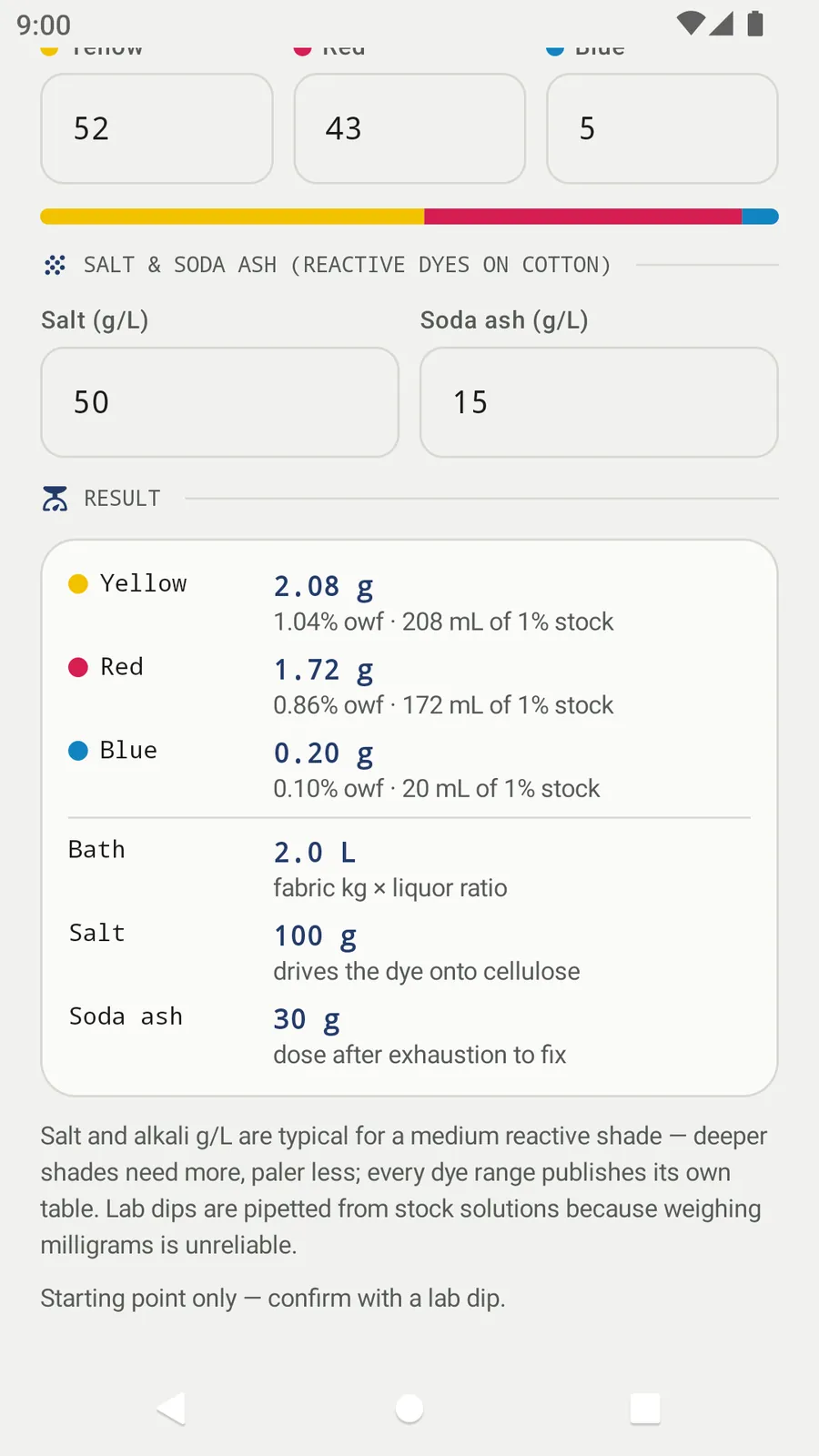
Worked through for the Rust example (200 g, 2.0% owf, Y 52 · R 43 · B 5, 1:10):
| Line | Sum | Result |
|---|---|---|
| Total dye | 200 × 2.0 ÷ 100 | 4.00 g |
| Yellow | 4.00 × 52% | 2.08 g (1.04% owf) |
| Red | 4.00 × 43% | 1.72 g (0.86% owf) |
| Blue | 4.00 × 5% | 0.20 g (0.10% owf) |
| Bath | 0.2 kg × 10 | 2.0 L |
| Salt | 2.0 L × 50 g/L | 100 g |
| Soda ash | 2.0 L × 15 g/L | 30 g |
Method 2: Stock (mL)
For lab dips, where you pipette dissolved dye because weighing a few milligrams is unreliable. Set Stock % w/v (1.00 means 1 g of dye per 100 mL). Each dye is shown in mL to pipette, then the Water needed to top the bath up to volume, plus salt and soda ash.
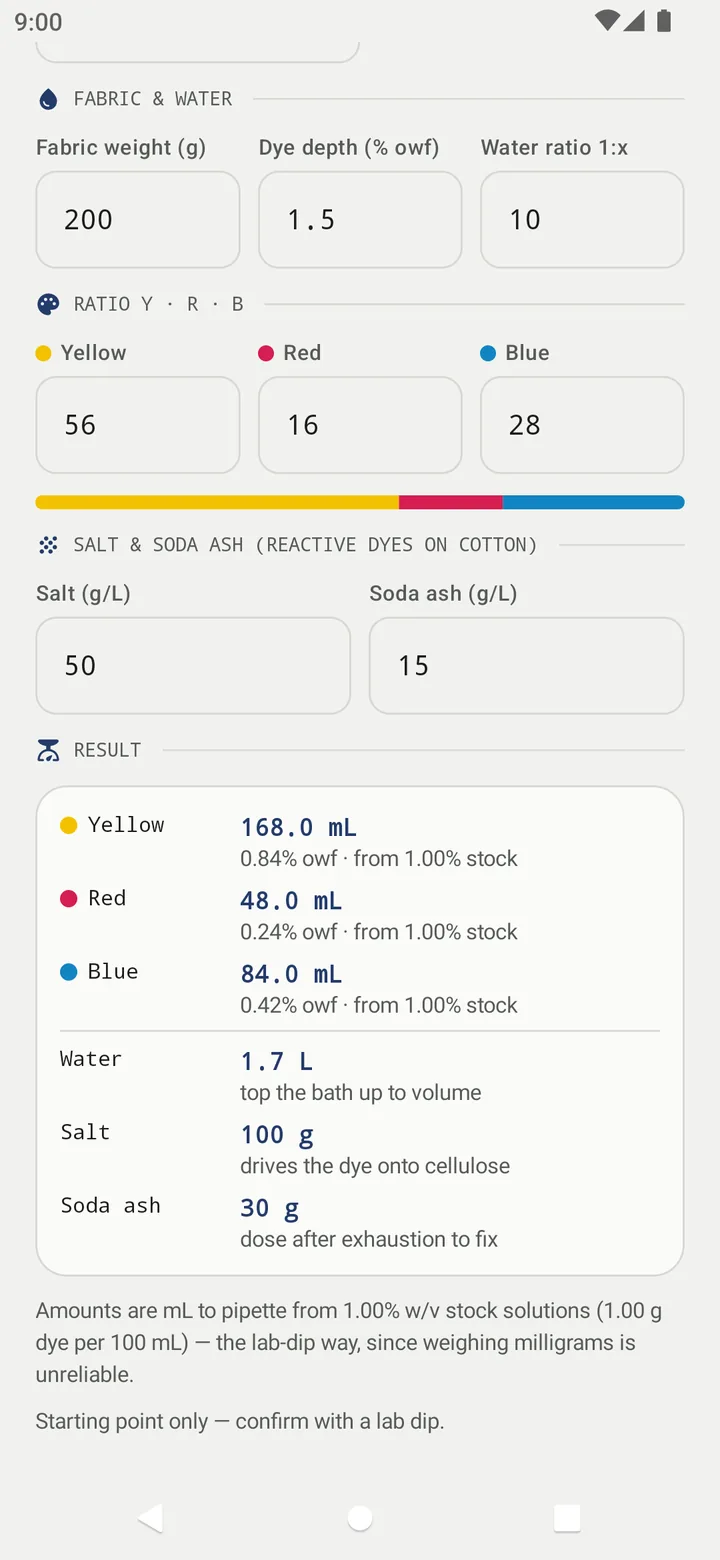
mL of stock = grams of dye × 100 ÷ stock %. For a small lab dip, scale the fabric weight down to your swatch (for example 10 g). How to prepare stocks: How to make and use a dye stock solution.
Method 3: Pad (g/L)
For continuous dyeing on a padder. Set Pick-up % (starts at 70): the grams of liquor the fabric keeps per 100 g after squeezing. Each dye is shown as g/L of pad liquor: g/L = % owf × 1000 ÷ pick-up %. At 0.84% owf and 70% pick-up that is 12.0 g/L.
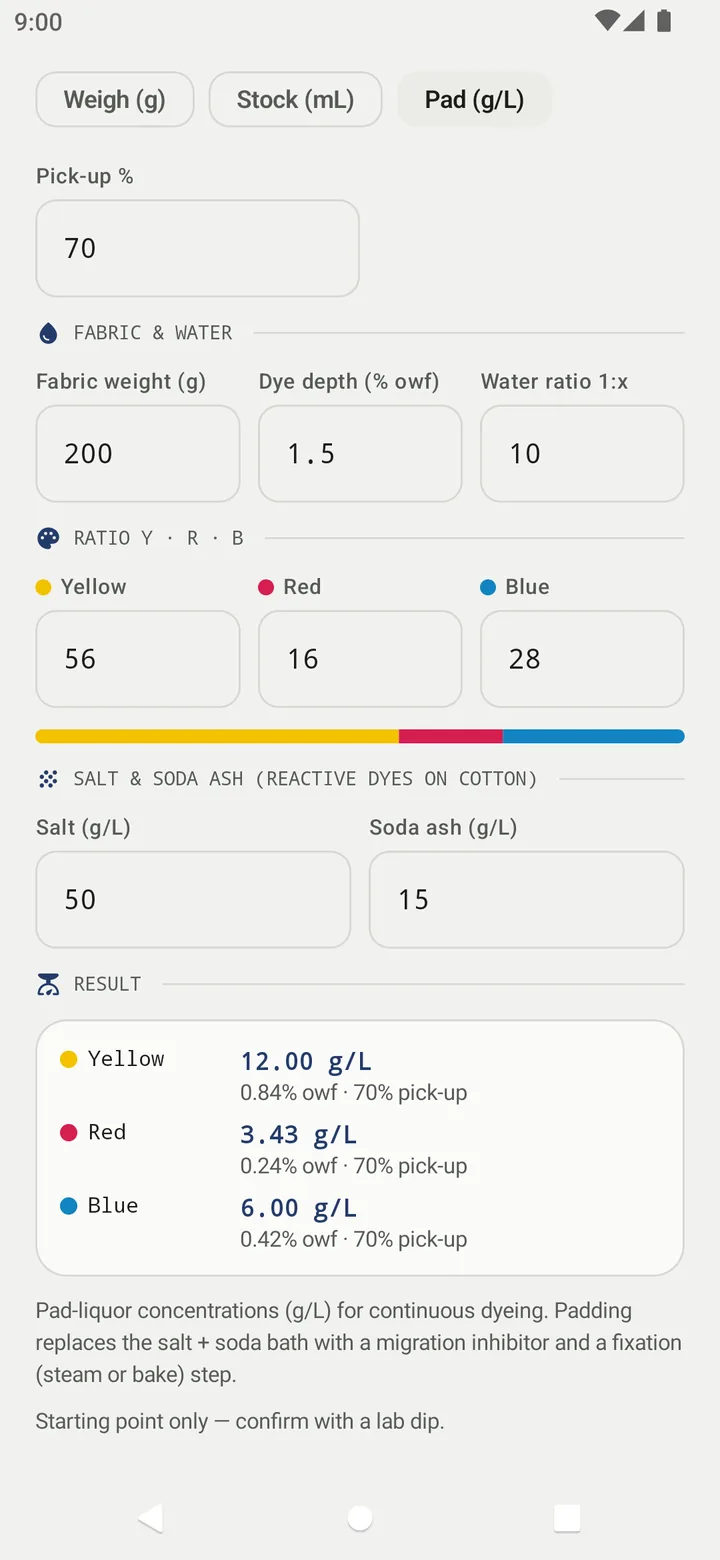
Padding replaces the salt and soda exhaust bath with a migration inhibitor and a fixation step (steam or bake), so no salt or soda lines are shown. Your pad recipe for alkali and auxiliaries comes from the dye supplier.
Salt and soda ash
For reactive dyes on cotton, salt drives the dye onto the fibre and soda ash is dosed after exhaustion to fix it. The defaults are typical for a medium reactive shade; the app's note says deeper shades need more, paler less, and every dye range publishes its own table.
Every result ends with Starting point only — confirm with a lab dip. Next: From recipe to lab dip.
Frequently asked questions
How is the amount of dye worked out?
Dye (g) = fabric weight (g) × % owf ÷ 100, split between yellow, red and blue by the ratio. 200 g at 2% owf is 4 g of dye in total.
Why are salt and soda ash given in g/L?
They are dosed per litre of bath, so their amounts follow the bath volume (fabric kg × liquor ratio), not the fabric weight. Change the water ratio and they change too.
What stock strength should I use?
The calculator starts at 1% w/v (1 g of dye per 100 mL). For very pale shades a weaker stock such as 0.1% gives larger, more accurate volumes to pipette.
Do the salt and soda ash figures suit every dye?
No. The defaults (50 g/L salt, 15 g/L soda ash) are typical for a medium reactive shade on cotton. Deeper shades need more, paler less; follow your dye supplier's table.
Does the calculator work without a capture?
Yes. Open Recipe calculator from the home screen and type any ratio and depth. It starts with a Rust example.
Was this article helpful?
Related articles
- From Shadecard recipe to lab dip: test, log and correctSave the measurement, dye a small swatch from the calculator's stock volumes, measure the dried dip, then Log dip with the outcome and correction. Promote a proven recipe to My shades.
- Understanding the trichromatic recipe (Y:R:B and % owf)A Shadecard recipe has two dials: the Y:R:B ratio sets the hue, the % owf sets how deep. Choose the fibre on the result to see the dye class; confirm everything with a lab dip.
- Take your first fabric colour reading, step by stepTap Capture dress color, keep White paper selected, lay the paper in the small dashed box and fill the big box with flat fabric, then tap the shutter once and hold still.
- Shadecard explained: what it does and who it is forShadecard measures a fabric's colour with a phone camera, matches it to a library of 13,297 shades and gives a yellow:red:blue starting recipe to confirm with a lab dip.
Need a hand?
Email us what you see on screen — a screenshot helps — and we'll walk you through it.