Lighting and framing for a good colour reading
In short
Use soft indirect daylight from one source, lay the fabric flat, fill the big box with plain cloth, tilt the phone about 30–45° and keep the reference card in the same light.
On this page
Good readings come from good light. Measure in soft, indirect daylight near a window with one light source, lay the fabric flat, fill the big box with plain cloth, keep the paper or card flat in the same light, and hold the phone slightly tilted (about 30–45°) about 15 cm away. The pill at the top of the preview warns you about shine and shadow before you tap.
The app's own checklist
Tap the ⓘ icon on Capture ×3 to open Capture tips. It lists what to enforce and what to avoid:
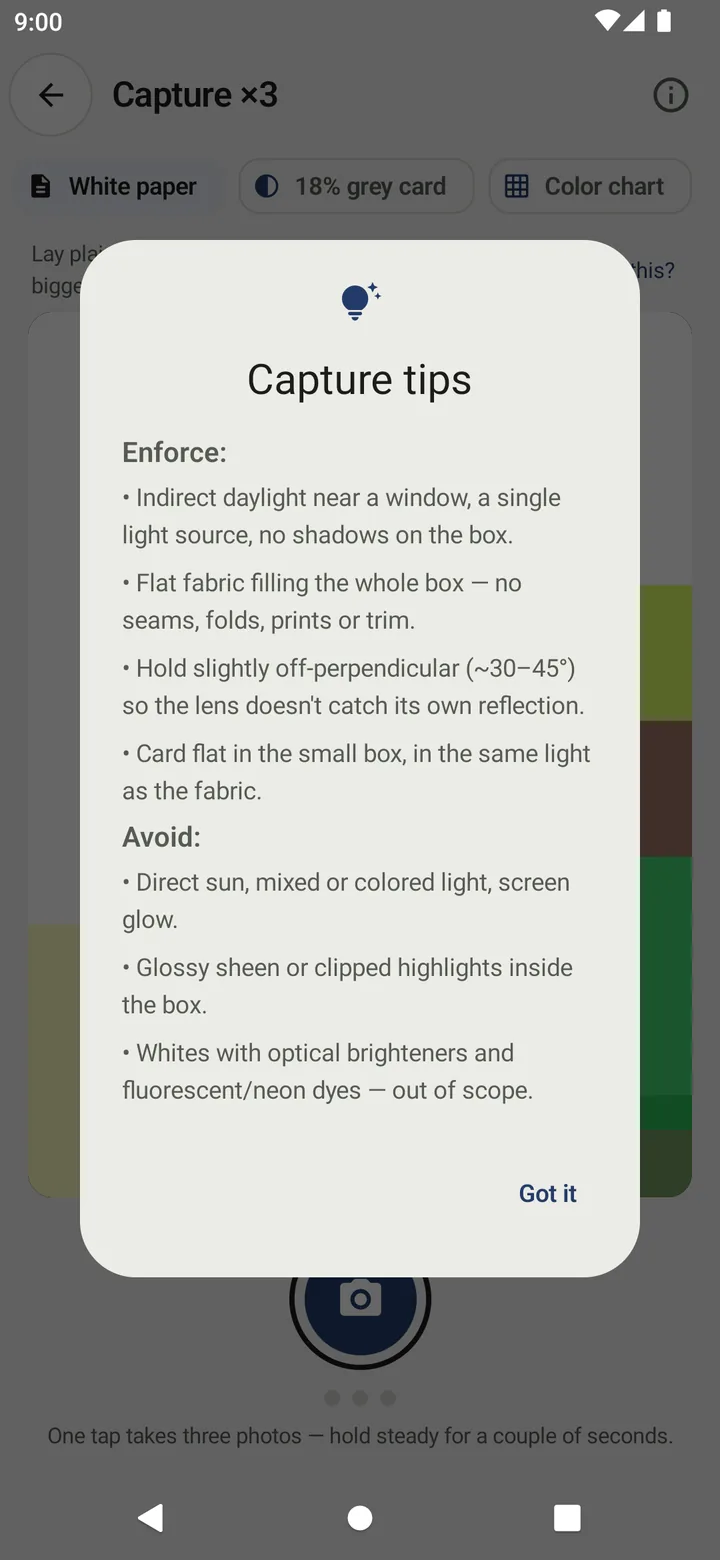
Enforce
- Indirect daylight near a window, a single light source, no shadows on the box.
- Flat fabric filling the whole box – no seams, folds, prints or trim.
- Hold slightly off-perpendicular (~30–45°) so the lens doesn't catch its own reflection.
- Card flat in the small box, in the same light as the fabric.
Avoid
- Direct sun, mixed or coloured light, screen glow.
- Glossy sheen or clipped highlights inside the box.
- Whites with optical brighteners and fluorescent/neon dyes – out of scope.
Light: why one source matters
The reference card corrects for the colour of the light, but only one colour of light at a time. Half window light and half warm bulb means the paper and the fabric may be lit differently, and no correction can fix both. Switch off room lamps when you are using window light, and keep away from coloured walls, signs and screens that throw coloured light onto the cloth.
Mains-powered lights pulse at 100 or 120 times a second. Shadecard sets the camera's anti-banding mode, and if it still sees stripes it adds Flicker banding seen to the result's HEADS-UP notes. Move to steadier light or change the angle.
Framing: what the box should see
- Plain colour only. If the area is uneven – a print, fold or mixed light – the result warns The area looks uneven with a ΔE value across the box.
- Flat and still. Smooth the cloth on a table. Folds create shadows; a moving hand makes the three photos disagree.
- Fill the box. The measurement is an average over the whole box, with the brightest and darkest 5% of pixels ignored to drop glints and the shadows between yarns.
- Distance about 15 cm. Too close and the camera may not focus; the app warns The photos look soft — possible blur.
Reading the live pill
Before you tap, a pill at the top of the preview checks the scene:
| Pill | Meaning | What to do |
|---|---|---|
| light looks good | No shine or shadow detected | Tap the shutter |
| too shiny — tilt a little | Part of the box is washing out | Tilt the phone further, or move away from direct light |
| shadow on the fabric | Something is shading the box | Check that the phone or your hand is not casting a shadow |
Sheen, pile and very dark cloth
Satin, velvet and other lustrous fabrics look different from every angle. Tilt until the pill clears, and measure the same way each time. Very dark shades (navy, black, deep maroon) give the camera little light to work with; use your best daylight for them and treat the result as the start of a lab dip.
Check how light-sensitive the reading is
After a match with a reference in the frame, the result screen offers a Light check:
- Keep the fabric and card exactly where they were.
- Tap Run light check (torch). The app returns to the capture screen with a banner, switches the torch on when you tap, and reads the fabric again.
- Back on the result, it reports Reading moved ΔE00 x.x between room light and torch with a verdict:
- under 1.5 – Stable under both lights.
- 1.5 to 3 – Some light sensitivity — check the dip in daylight before approving.
- over 3 – Sensitive to the light source. Consider the next candidate shade.
The light check does not use a scan. It is an early warning, not a metamerism test: a true metamerism test needs the target and the dyed sample together under standard lights. More in Metamerism: why lighting changes colour.
Related
Frequently asked questions
Can I measure under tube lights or LED bulbs?
You can, but indirect daylight is the target. Mains-powered LEDs can flicker and stripe the photo; the app warns about flicker banding when it sees it.
Why tilt the phone instead of holding it straight?
Held perfectly square, the lens can catch its own reflection off the cloth. Tilting about 30–45° avoids that shine.
Can I measure a printed fabric?
Only if you can fill the box with one plain colour. Averaging a print gives a colour that isn't really on the cloth, and the app warns when the area looks uneven.
What does the light check tell me?
It re-reads the same fabric with the phone torch on and reports how far the reading moved. A big shift means the shade may look different under other lights.
Was this article helpful?
Related articles
- White paper, grey card or colour chart? Choosing a referenceWhite paper is the everyday reference and unlocks shade plus recipe. An 18% grey card is more reliable. A 24-patch colour chart gives full colour correction. No card: family only.
- Couldn't get a clean reading: fix a rejected captureA rejection names the guard that failed: photos that disagree, persistent glare, an overexposed card or an unreadable chart. Fix that one thing and tap Retake; no scan is used.
- Take your first fabric colour reading, step by stepTap Capture dress color, keep White paper selected, lay the paper in the small dashed box and fill the big box with flat fabric, then tap the shutter once and hold still.
- Use the recipe calculator: grams, stock solution or pad liquorEnter fabric weight, depth (% owf), water ratio and the Y:R:B ratio. Pick Weigh (g), Stock (mL) or Pad (g/L); the calculator gives each dye plus bath volume, salt and soda.
Need a hand?
Email us what you see on screen — a screenshot helps — and we'll walk you through it.