Metamerism: why lighting changes fabric colour
Metamerism is when two fabrics match under one light but not another, because their reflectance spectra differ. Check matches under several standard lights before approval.
On this page
Metamerism is when two colours match under one light and stop matching under another. A dyed dip can look perfect beside the customer's swatch under the lab's tube light, then turn visibly redder or greener in daylight. It happens because the two fabrics reflect light differently across the spectrum; under the first light the differences cancel out, under the second they do not. The cure is to check every match under several agreed lights before approval.
Three things make a colour
What you see depends on three things at once:
- The light – how much energy it has at each wavelength. Daylight, a warm bulb and an LED tube have very different spectra.
- The surface – how much of each wavelength the dyed fibre reflects (its reflectance curve).
- The observer – the eye's three types of cone, or a camera's three colour channels.
Your eye reduces the whole spectrum of reflected light to three signals. Many different spectra produce the same three signals, so two different fabrics can look identical. Change the light, and the signals from each fabric change by different amounts.
Kinds of metamerism
- Illuminant metamerism – the classic dye-house problem: a match under one lamp, a mismatch under another.
- Observer metamerism – two people with normal colour vision disagree about whether a pair matches, because their eyes' sensitivities differ slightly.
- Device (camera) metamerism – a camera's colour channels do not respond like the eye, so a pair that matches to the eye may not match in a photo, and vice versa.
- Geometric effects – the match changes with viewing angle, common in lustrous or piled fabrics.
A related effect is colour inconstancy: a single sample that shifts a lot in appearance between lights, even with nothing to compare it to.
Why it happens in dyeing
Metamerism appears when the target and the dip get their colour from different colorants:
- The buyer's standard was dyed with dyes you do not have, or it is a printed card, paint chip or plastic.
- A garment combines fibres – cotton body, polyester trim, nylon zip – each dyed with a different dye class.
- A shade was saddened with a complement in one recipe and built from a duller dye in another.
Each colorant has its own reflectance curve. Matching the colour under one light means matching the result, not the curve.
A typical case
A jacket has a cotton body dyed with reactive dyes and a polyester trim dyed with disperse dyes. In the factory, under tube lighting, the lab matches the trim to the body and both look the same shade of khaki. The garment reaches a shop window in daylight and the trim now looks slightly greener than the body. Nothing was dyed wrongly: the two fibres carry different dyes with different reflectance curves, and the match only held under one light.
The fix is not to re-dye blindly but to match again with both parts side by side under the buyer's primary light and the secondary lights, choosing dyes for the trim whose behaviour across lights is closer to the body's.
The standard lights
Buyers and dye houses agree the lights in advance, usually in a light booth that switches between them:
| Name | What it represents |
|---|---|
| D65 | Average daylight; the usual primary illuminant |
| A | Incandescent / tungsten bulb light |
| Store fluorescent (such as TL84 or CWF) | Typical retail tube lighting |
| LED sources | Increasingly used in stores and homes |
The primary illuminant is where the match must pass; the others are where metamerism is checked.
How to check a match for metamerism
- Put the dip and the standard side by side in the booth, same orientation, same area visible.
- Judge under the primary light first.
- Switch to each secondary light and look for a change in the relationship: does one become redder, greener or deeper than the other?
- Record what you see with the illuminant name.
With a spectrophotometer you can go further: measuring both reflectance curves lets software calculate the colour difference under each illuminant and a metamerism index.
How to reduce it
- Use similar dyes to the target when you know what it was dyed with.
- Keep dye types consistent across all components of a garment where the fibres allow.
- Match under the buyer's primary light, never only under the lab's convenient lamp.
- Prefer recipes close to the target's structure: a muted shade built from a naturally dull dye can behave differently across lights from one built by heavily saddening a bright dye.
- Record the lights on every approval.
What a phone can and cannot tell you
A phone camera is itself an observer with its own sensitivities, and it records only three channels. It cannot see the reflectance curve, so it cannot detect metamerism between two samples. This is also one reason two phones can read the same cloth differently (see Why two phones read the same fabric differently).
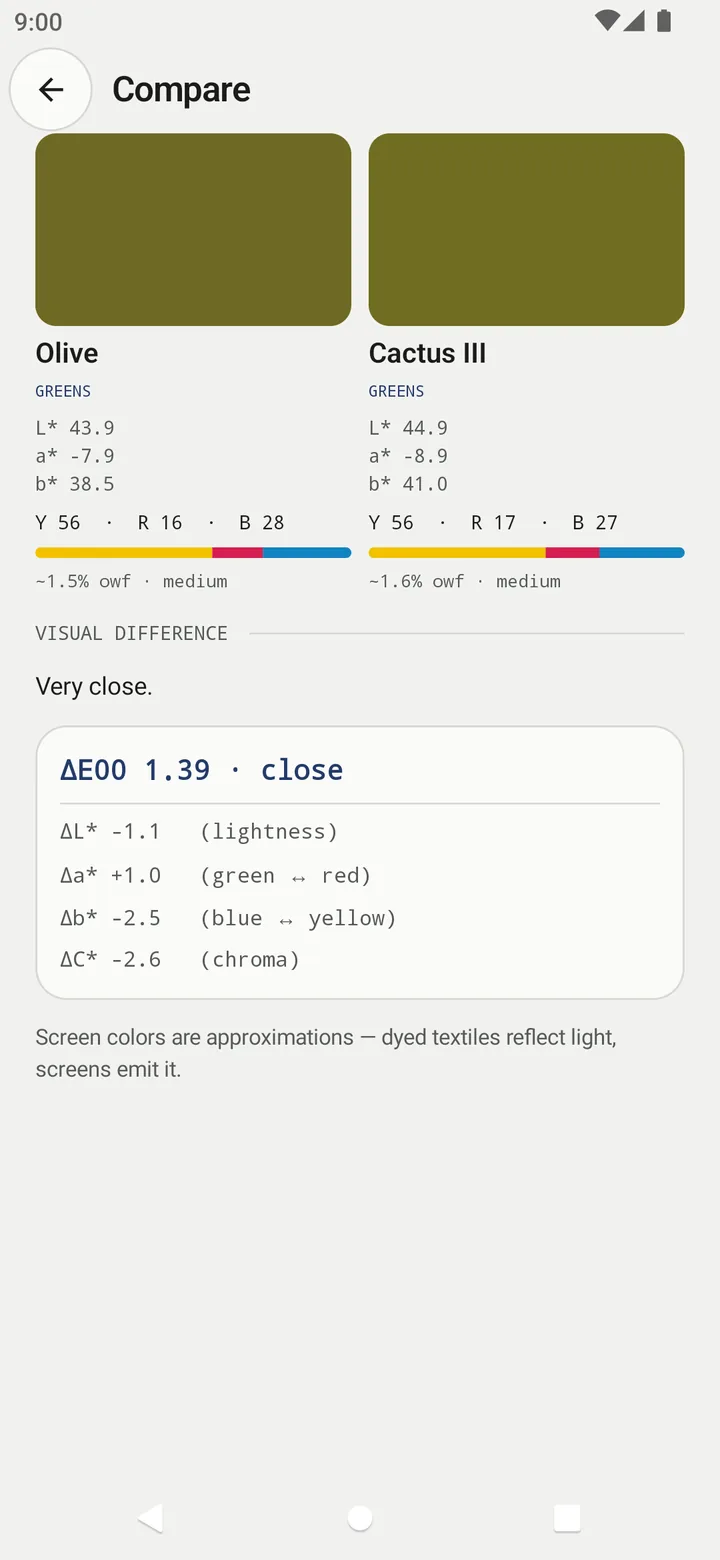
Shadecard offers a cheaper early warning called the Light check. After a match, it re-reads the same fabric with the phone's torch on, through the same reference correction, and reports how far the reading moved between room light and torch:
| Shift (ΔE00) | App's verdict |
|---|---|
| under 1.5 | Stable under both lights |
| 1.5–3 | Some light sensitivity – check the dip in daylight before approving |
| over 3 | Sensitive to the light source – consider the next candidate |
The app is careful to call this an illuminant-sensitivity check, not a metamerism test: in its own words, a true metamerism test needs target and sample together under standard lights. It is a prompt to look harder, not a verdict. How to run it: Lighting and framing for a good reading.
Key points
- Metamerism means a match that holds under one light and fails under another.
- It comes from different reflectance spectra, usually from different colorants.
- Agree the lights with the buyer and check every dip under all of them.
- Phones and cameras cannot detect it; a light booth or spectrophotometer can.
Related reading: CIELAB and Delta E (ΔE2000) explained for dyers and The lab dip process explained.
Frequently asked questions
What is metamerism in simple words?
Two colours that look the same under one light but different under another. It happens because the two surfaces reflect light differently across the spectrum, even though the totals your eye sees happen to match under the first light.
What lights are used to check metamerism?
Usually a daylight source such as D65 plus one or two others the garment will be seen under, such as incandescent (illuminant A) or store fluorescent lighting, compared side by side in a light booth.
How do dyers reduce metamerism?
By matching with dyes similar to those in the target, keeping the same dye types across all parts of a garment, and approving under the buyer's agreed lights rather than a single lamp.
Can a phone camera detect metamerism?
No. A camera records three colour channels, not the reflectance spectrum, so it cannot predict how two samples will compare under another light. Only a side-by-side check under several lights or a spectrophotometer can.
Was this post helpful?