How to make and use a dye stock solution for lab dips
A 1% w/v stock is 1 g of dye made up to 100 mL. To dose a recipe, pipette mL = grams of dye × 100 ÷ stock %. Use a 0.1% stock for pale components so the volumes stay measurable.
On this page
A dye stock solution is dye dissolved at a known strength so that you can dose small amounts by volume instead of weighing milligrams. The usual lab strength is 1% w/v – 1 g of dye made up to 100 mL of solution. To dose a recipe, pipette mL = grams of dye × 100 ÷ stock %. For very pale components, a 0.1% stock keeps the volumes large enough to measure accurately.
Why labs use stock solutions
A lab dip might use a 10 g swatch. At 0.1% owf, one dye component is 0.01 g – ten milligrams. Weighing that on a normal balance is guesswork, and a tiny error is a big relative error. Dissolve 1 g in 100 mL and the same 0.01 g becomes 1 mL, which a pipette measures easily.
What you need
- A balance reading to at least 0.01 g (0.001 g is better).
- Volumetric flasks (100 mL, 250 mL) or accurate measuring cylinders.
- Graduated pipettes or lab syringes, one per dye.
- Beakers, a stirring rod, a wash bottle.
- Soft, preferably distilled or deionised water. Hard water can react with some dyes.
- Labels and a marker.
- Gloves, safety glasses and a dust mask for handling powder.
Make a 1% stock (100 mL)
- Put on gloves, glasses and a dust mask. Open the dye container gently to avoid raising dust.
- Weigh 1.00 g of dye powder into a small beaker.
- Add a little cold water and stir to a smooth paste, so no lumps remain.
- Add warm water at the temperature your dye maker recommends and stir until fully dissolved.
- Pour into a 100 mL volumetric flask. Rinse the beaker two or three times with small amounts of water and add the rinses to the flask.
- Let it reach room temperature, then fill exactly to the mark.
- Stopper and mix by inverting several times.
- Label it: dye name, lot number, 1% w/v, date, your initials.
For a 0.1% stock, pipette 10 mL of the 1% stock into a 100 mL flask and make up to the mark.
How much to pipette
For each dye in the recipe:
- Dye (g) = swatch weight (g) × that dye's % owf ÷ 100
- Stock (mL) = dye (g) × 100 ÷ stock %
Then water (mL) = bath volume − total stock volume, where bath volume = swatch weight × liquor ratio.
Worked example
A 10 g cotton swatch, recipe Y 52 · R 43 · B 5 at 2% owf, liquor ratio 1:10, reactive dyes.
| Sum | Result | |
|---|---|---|
| Bath volume | 10 g × 10 | 100 mL |
| Total dye | 10 × 2 ÷ 100 | 0.200 g |
| Yellow (52%) | 0.104 g × 100 ÷ 1 | 10.4 mL of 1% stock |
| Red (43%) | 0.086 g × 100 ÷ 1 | 8.6 mL of 1% stock |
| Blue (5%) | 0.010 g × 100 ÷ 1 | 1.0 mL of 1% stock, or 10 mL of 0.1% |
| Water | 100 − 10.4 − 8.6 − 10 | 71 mL (using the 0.1% blue) |
| Salt at 50 g/L | 0.1 L × 50 | 5 g |
| Soda ash at 15 g/L | 0.1 L × 15 | 1.5 g |
Using the 0.1% stock for blue turns an awkward 1.0 mL into a comfortable 10 mL. The salt and soda figures are typical for a medium reactive shade; use your dye supplier's table for your depth.
Doing it in Shadecard
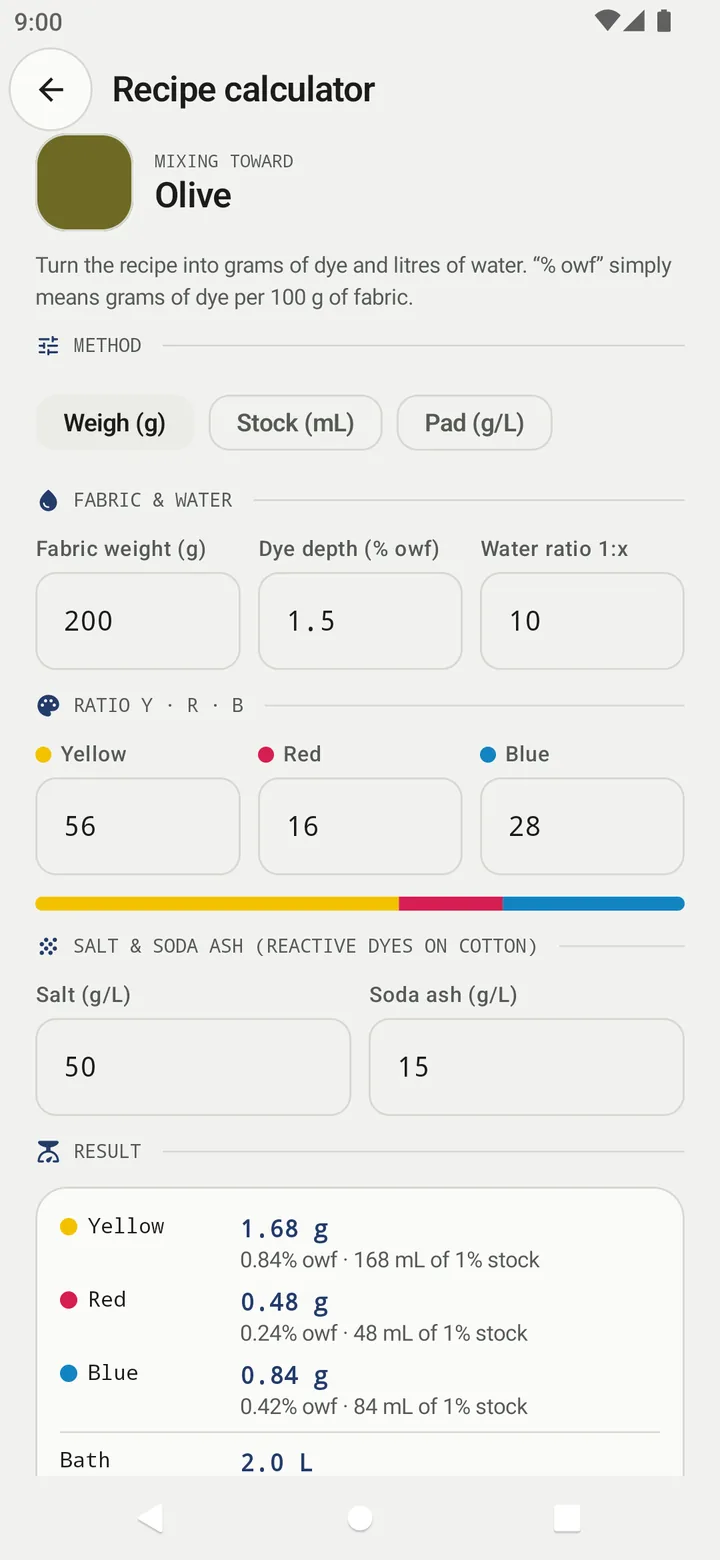
Shadecard's Recipe calculator has a Stock (mL) method that does this arithmetic:
- Open the calculator from a result (Work out the amounts), a shade page, or the home screen.
- Tap Stock (mL) under Method and set Stock % w/v (it starts at 1).
- Enter your swatch weight in Fabric weight (g) and your lab liquor ratio in Water ratio 1:x.
- Read the mL of each dye, the Water to top the bath up to volume, and the salt and soda ash.
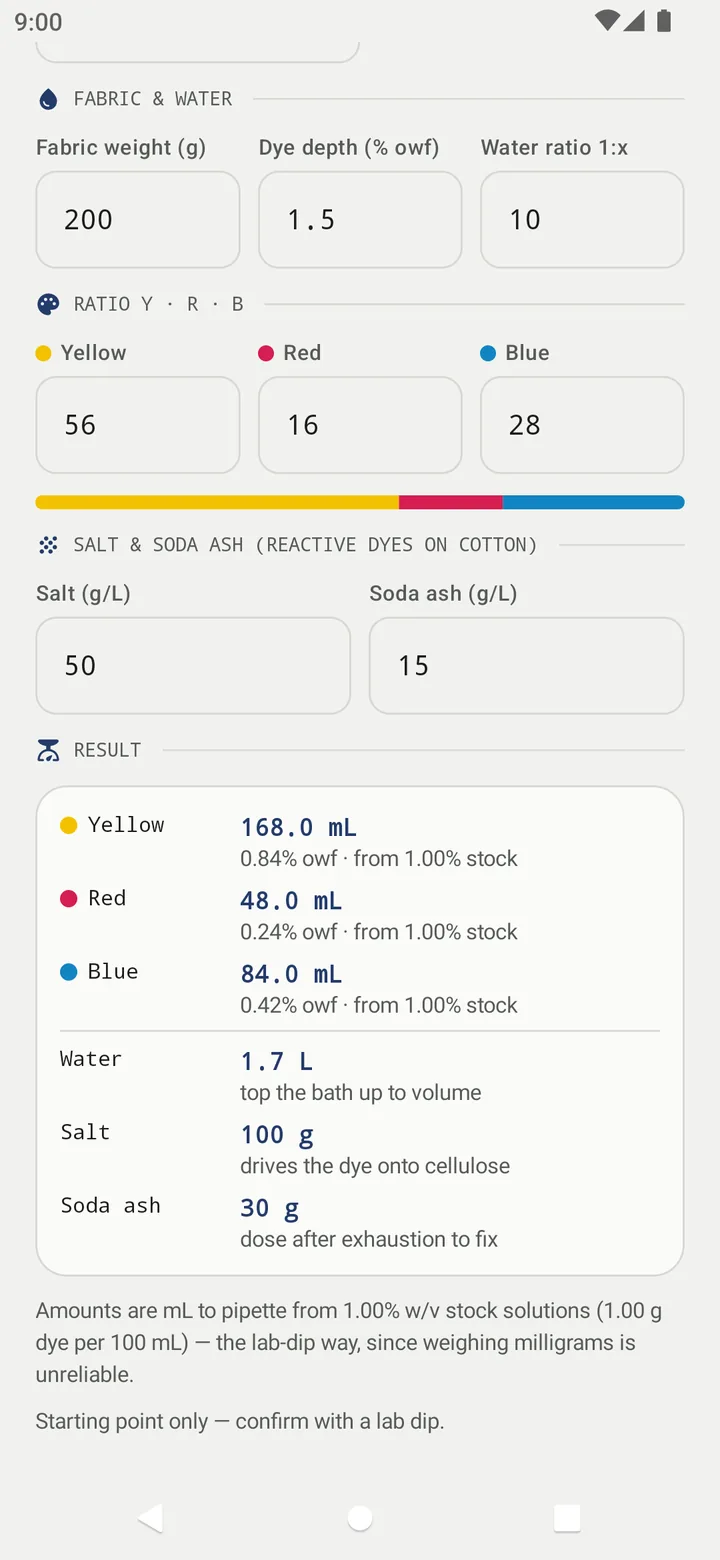
The stock % applies to all three dyes at once, so for a mixed-strength setup (1% yellow and red, 0.1% blue) calculate the weak one separately, or run the calculator twice. More: Use the recipe calculator.
Accuracy habits
- Keep volumes above about 1 mL. If a component needs less, use a weaker stock.
- One pipette per dye, rinsed after use, so stocks do not cross-contaminate.
- Read at eye level, at the bottom of the meniscus.
- Never pipette by mouth. Use a pipette filler or a syringe.
- Record everything: stock date, lot and the volumes used for each dip.
Storage and shelf life
- Reactive dye stocks slowly react with the water (hydrolysis) even without alkali, and more quickly when warm. Make them fresh, follow the dye maker's guidance on how long they keep, and never add alkali (soda ash) to a stock.
- Acid and direct dye stocks usually keep longer, but watch for sediment or mould.
- Store stocks covered, cool and out of light, in labelled bottles kept apart from food and drink.
- If a stock shows sediment or has changed colour, discard it and make a new one.
Safety
Dye powders can cause allergic and breathing problems in people who are exposed repeatedly; make stocks where there is good ventilation, wear a dust mask, and clean spills with a damp cloth. Stock solutions reduce powder handling, which is one more reason to use them. For salt and soda ash handling, see Reactive dyeing basics: salt and soda ash.
A stock solution makes a lab dip precise; it does not make the recipe right. That is what the dip is for – see The lab dip process explained.
Frequently asked questions
What does 1% w/v stock solution mean?
1 gram of dye in every 100 mL of finished solution (10 g per litre). So 1 mL of it contains 0.01 g of dye.
How many mL of stock do I need?
mL = grams of dye needed × 100 ÷ stock %. For 0.104 g of dye from a 1% stock, that is 10.4 mL.
How long does a reactive dye stock solution keep?
Not long. Reactive dyes slowly react with water even without alkali, so make stocks fresh and follow the dye maker's advice. Never add alkali to a stock.
Do I subtract the stock volume from the water?
Yes. The stock solutions are part of the bath. Top up with water to the total bath volume, not by the full bath volume on top of the stocks.
Was this post helpful?