How to complete a khatm of the Quran in Ramadan: a realistic plan
The 604-page mushaf has 30 juz, so one khatm in Ramadan is about one juz, or 20 pages, a day. Four pages after each of the five prayers does it. Plan for 29 days and keep a catch-up slot.
On this page
To complete the Quran in Ramadan, read about one juz a day. The common 604-page mushaf has 30 juz of about 20 pages each, so 20 pages a day finishes it in 30 days; 21 a day finishes it in 29. The simplest way to fit that in is four pages after each of the five daily prayers. Plan for 29 days, keep one catch-up slot a day, and track where you are.
The numbers
| Juz (parts) | 30 |
| Hizb (half-parts) | 60 |
| Surahs | 114 |
| Ayahs | 6,236 in the common (Kufan) count |
| Pages | 604 in the Madani mushaf found in most mosques |
Ramadan has 29 or 30 days, depending on the moon, so plan for 29 and treat the 30th as a bonus. Mushafs printed in South Asia often have a different number of pages, but the juz are the same, so plan in juz if your page count differs.
Choose your plan
| Goal | Per day | After each of the 5 prayers |
|---|---|---|
| Half the Quran | 10 pages (half a juz) | 2 pages |
| One khatm | 20–21 pages (1 juz) | 4 pages |
| Two khatms | 40–42 pages (2 juz) | 8 pages |
| Three khatms | 60–63 pages (3 juz) | 12 pages |
Be honest about your time. A khatm completed is worth more to you than an ambitious plan dropped in the first week. The Prophet ﷺ advised Abdullah ibn Amr, who wanted to recite more, to complete the Quran in a month, as reported by al-Bukhari, and later allowed him to do it in seven days but no less; scholars have long encouraged reciting with attention rather than racing.
Fit it into the day
Four pages after each prayer works because it hangs the reading on fixed points of the day:
- after Fajr, often the quietest time;
- after Dhuhr and Asr, a short break in work or study;
- after Maghrib, once you've broken the fast;
- after Isha or Taraweeh.
If one slot doesn't work for you, move it: before suhoor, on the commute (reading on a phone), in a lunch break. Keep the total, not the exact timetable.
Read with understanding
Speed and understanding pull against each other. A few ways to keep both:
- Read the translation of one page a day alongside the Arabic, or a short tafsir of the passage the imam will recite that night.
- Keep a small notebook for ayahs that stop you, to look up or ask about.
- Recite clearly, with tajwid. A khatm read carefully at a steady pace is better than one rushed. If you're working on your tajwid, our article on lahn jali and lahn khafi explains the mistakes to watch.
Follow the Taraweeh khatm
Many mosques aim to complete the Quran in Taraweeh over Ramadan, at roughly a juz a night, sometimes more in the early nights so the khatm falls in the last ten. It's a recommended practice in many communities, not an obligation, and mosques differ.
If your mosque does a khatm, you can:
- Read ahead in the morning what the imam will recite that night, so you follow the meaning in the prayer.
- Revise along if you're a hafiz, reciting the next night's juz to yourself.
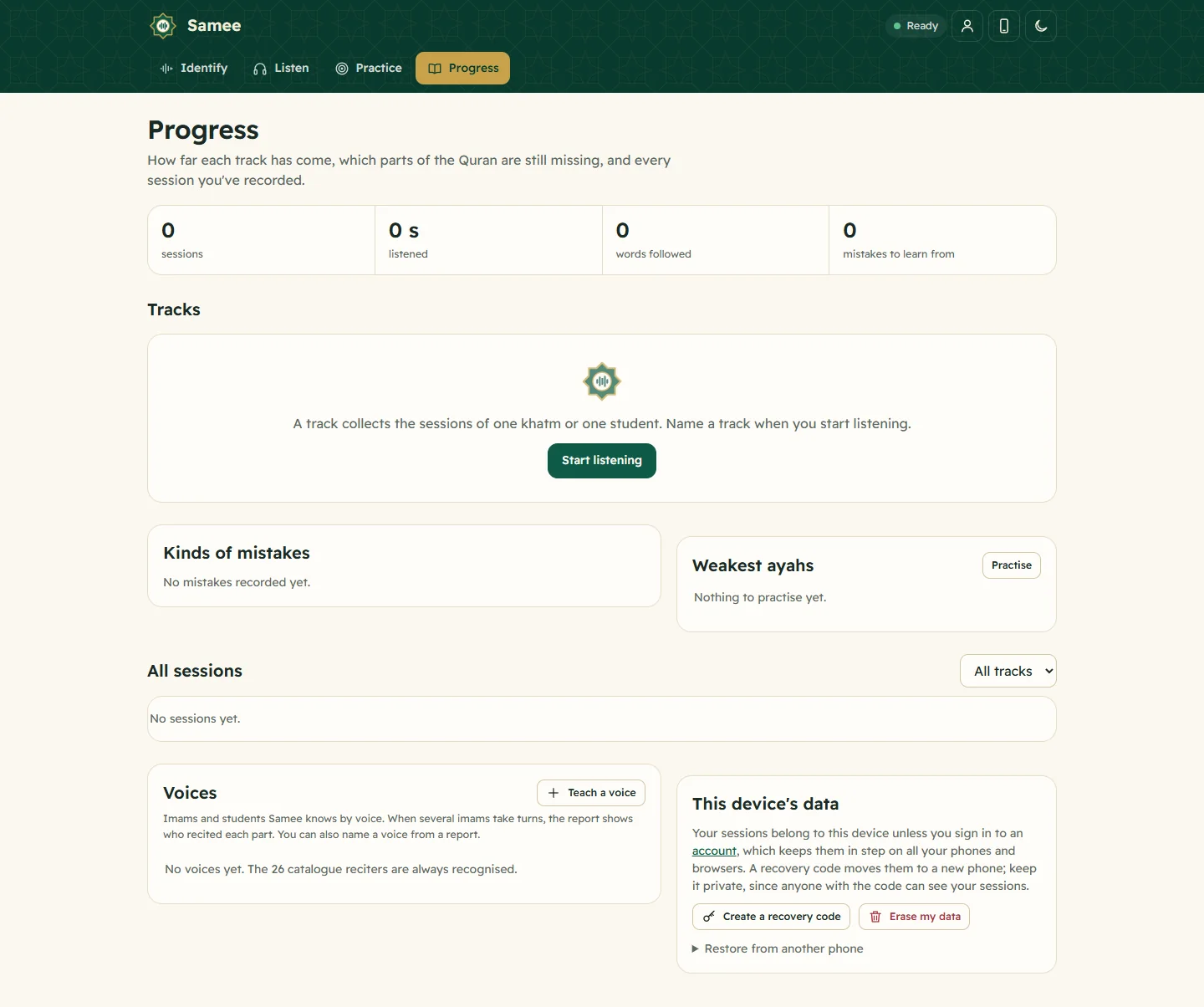
- Keep a record. In Samee, give every night's session the same track, such as Taraweeh 1448. Each night continues where the last stopped, and the khatm map shows the mushaf page by page with what's been recited, the nights, and any gaps, such as a night you missed or ayahs skipped. See tracks and the khatm map.
Do set the phone up before the prayer and leave it be; following Taraweeh covers the etiquette.
Track your own khatm
A plan needs a marker. Options:
- A bookmark or ribbon in your mushaf, and a tick on a 30-box chart on the fridge.
- A reading app that remembers your page.
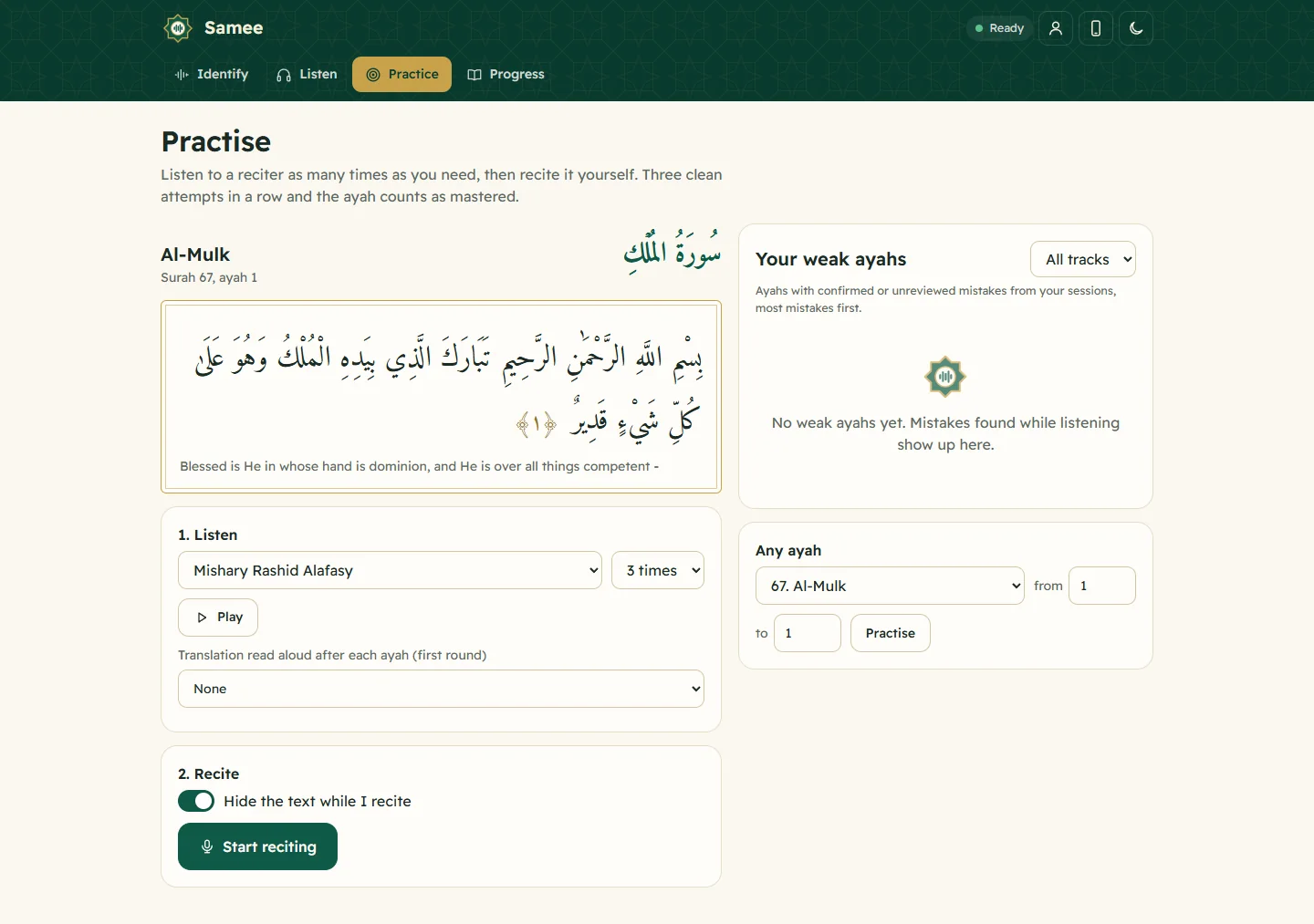
- Reciting to Samee: start a Listen session under a track named for your khatm each day and recite your portion. The track remembers where you stopped, and its map shows your progress and any pages you skipped. This works best for reciting aloud from memory or from the mushaf at a steady pace.
When you fall behind
Everyone has days that go wrong: illness, guests, travel.
- Don't stop. Missing a day is normal; abandoning the plan isn't necessary.
- Spread the catch-up. Add a page or two to each prayer for a few days rather than reading a whole juz extra at once.
- Use the long nights. The last ten nights are when many people increase their worship anyway.
- Adjust the goal if you must. Reaching half the Quran with care is better than nothing.
Women who don't pray or fast for part of the month may find the rulings on reciting and touching the mushaf in that time differ between the schools. Many keep listening to the Quran, reading translations and making dhikr. Ask a scholar you trust about your own practice.
A sample week
| Day | Juz | Pages (Madani mushaf) |
|---|---|---|
| 1 | 1 | 1–21 |
| 2 | 2 | 22–41 |
| 3 | 3 | 42–61 |
| 4 | 4 | 62–81 |
| 5 | 5 | 82–101 |
| 6 | 6 | 102–120 |
| 7 | 7 | 121–141 |
Each later juz is also about 20 pages, with Juz 30 a little longer at 23. Prepare for Ramadan by trying the routine for a few days beforehand, so the first week isn't the hardest.
For the practical side of the month, such as suhoor and iftar times, see Ramadan suhoor and iftar timing tips.
Frequently asked questions
How many pages a day to finish the Quran in Ramadan?
About 20 pages a day in the common 604-page mushaf, which is one juz. Over 29 days that's 21 pages a day; over 30 days, a little over 20.
How long does one juz take to read?
It varies with pace and fluency. Many people read a juz in roughly half an hour to an hour. Time yourself on the first day and plan from that.
Is it better to finish the Quran or to read with understanding?
Both are valued. Many people aim for one khatm and add a translation or tafsir of a shorter portion each day, so that reflection doesn't depend on speed.
Does listening to the Taraweeh khatm count as my own khatm?
Listening to the Quran is rewarded and worthwhile, but scholars generally distinguish it from reciting yourself. Many people aim to complete their own recitation as well as follow the mosque's khatm.
What if I fall behind?
Don't abandon the plan. Add one or two pages to each prayer until you've caught up, use the weekend or the last ten nights, or adjust the goal. A smaller khatm completed is better than a large one abandoned.
Was this post helpful?