Introducing Samee: a listener for Quran recitation
Samee (سامع, "the one who listens") identifies a Quran recitation, follows an imam or student word by word to mark mistakes, tracks a khatm and helps you practise. It runs in your browser, no sign-up.
On this page
Samee (سامع, "the one who listens") is a companion for Quran recitation, and it's now open at samee.abdohoo.app. Hold your phone up to a recitation and it tells you the surah, the ayah and the reciter. Let it follow a Taraweeh imam or a hifz student, and it marks missed, wrong and skipped words as they happen. It keeps every session, maps a khatm page by page, and gives you a practice list of the ayahs that went wrong. It runs in your browser, with no sign-up.
Why we built it
Recitation is heard far more than it is read. A passage on the radio, an imam in Taraweeh, a student reciting the day's lesson, a hafiz revising alone: in each case someone is listening, and wants to know where is this?, was that right? or how much is left?. Samee is a tool for that listener. It doesn't replace the teacher or the hafiz behind the imam; it gives them a second pair of ears and a memory.
What Samee does
Identify a recitation
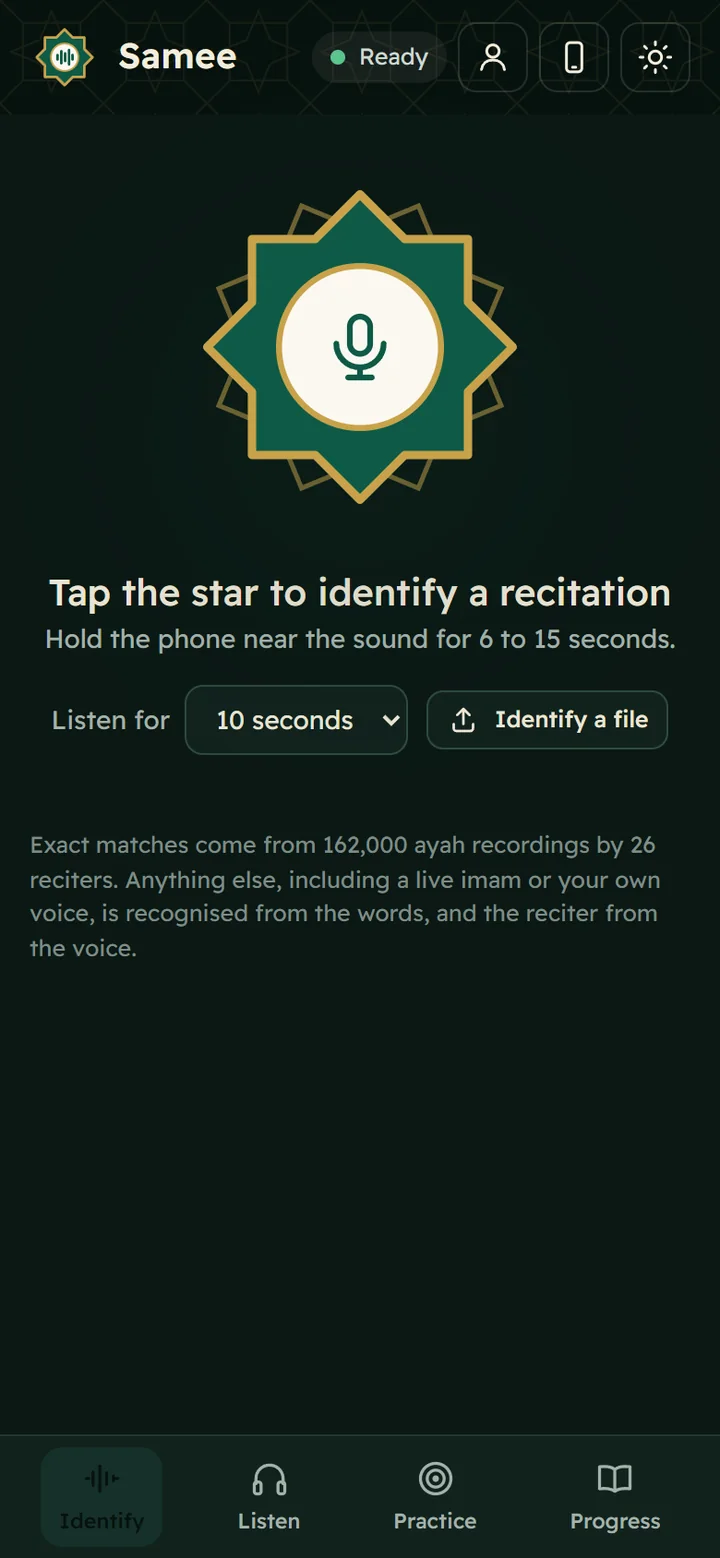
Tap the star and hold the phone to the sound for 6, 10 or 15 seconds, or choose a file. Samee matches the sound against about 162,000 ayah recordings by 26 well-known reciters. If it isn't one of those recordings, a live imam or your own voice for instance, it recognises the words and finds them in the Quran, and names the reciter from the voice when it can. You get the surah, the ayahs, the juz and page, and buttons to follow along or practise.
How identifying a recitation works
Listen and correct
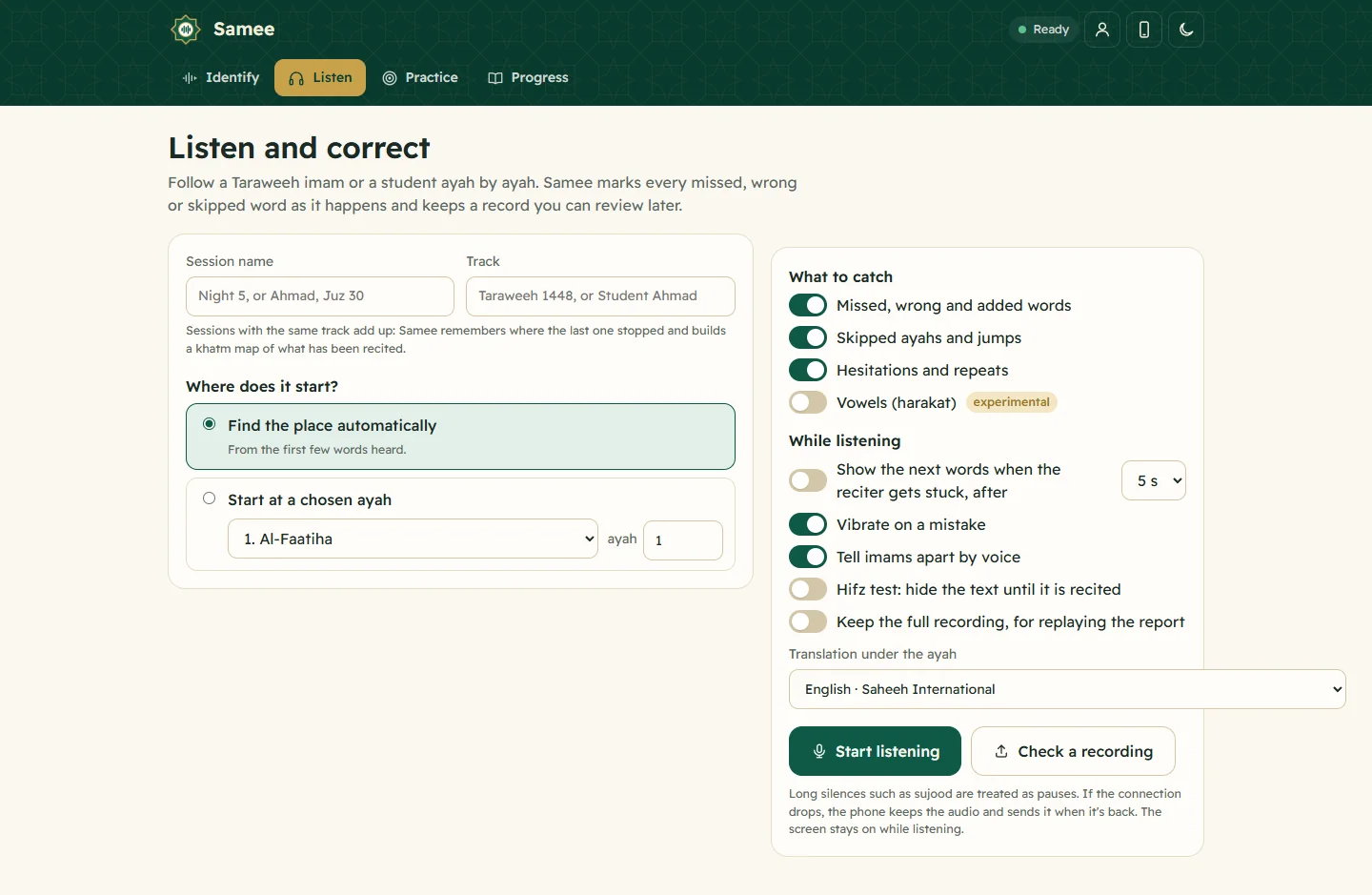
Name the session, choose where it starts, or let Samee find the place, and tap Start listening. Samee follows word by word and marks, as they happen:
- missed, wrong and added words;
- skipped ayahs, and jumps to a similar passage elsewhere;
- hesitations and repeats;
- experimentally, vowels that may differ from the text.
Each finding comes with a few seconds of audio. Samee knows the shape of Taraweeh: Al-Fatiha in each rak'ah, a silent basmalah, ruku and sujood, the sajdah of recitation and the qunoot. It tells imams apart by voice when they take turns. If the reciter gets stuck, it can show the next words on screen (talqeen). And if the mosque Wi-Fi drops, the phone keeps the audio and sends it when the connection returns.
Sessions, tracks and the khatm map
Every session is saved with a report: findings by ayah, with clips to play, buttons to confirm or dismiss each one, notes, a printable PDF and a spreadsheet export. Give sessions a track, one per khatm or per student, and Samee continues each from where the last stopped and draws the mushaf juz by juz, one square per page, with the gaps and skipped ayahs marked.
Practise and test your hifz
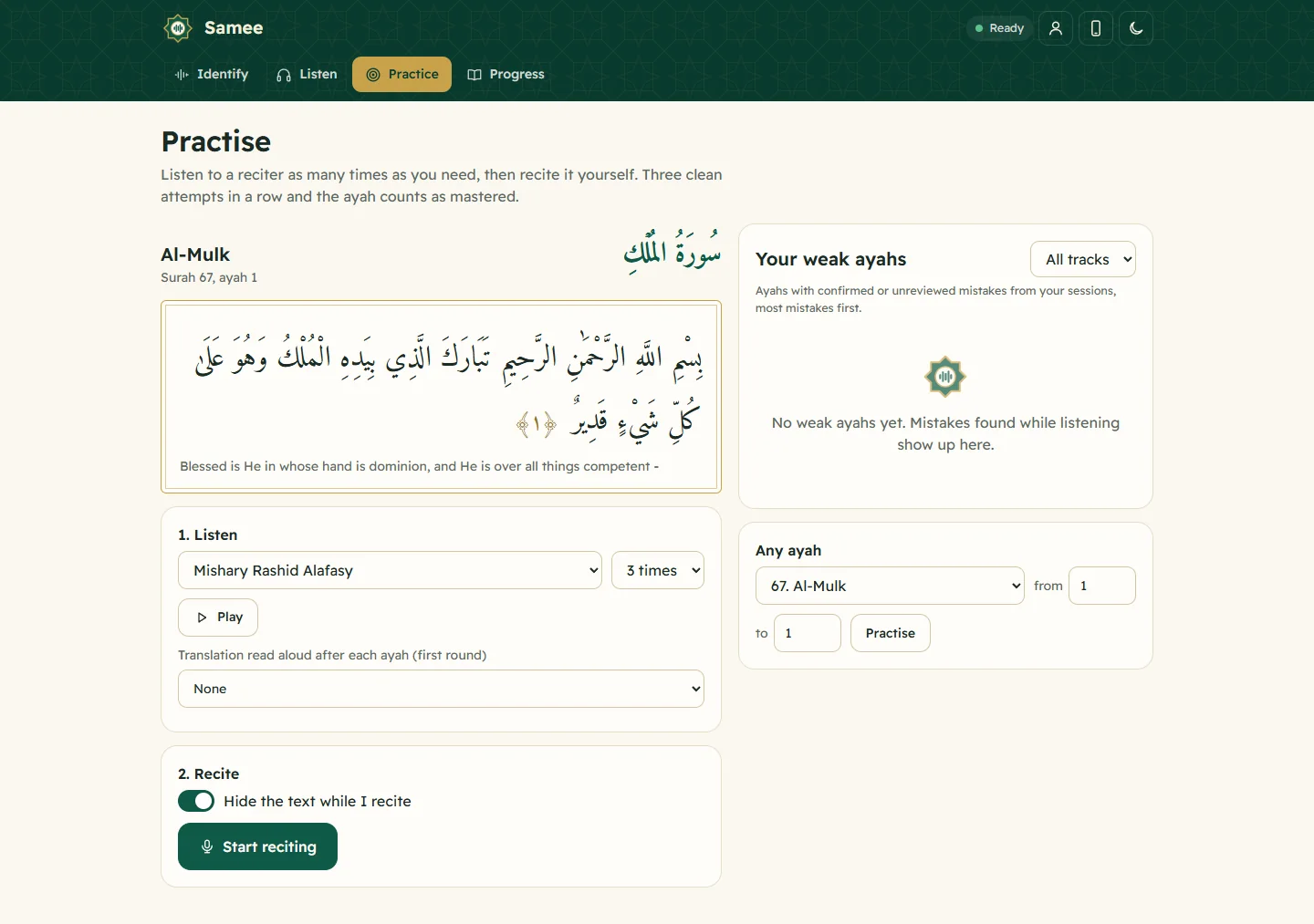
Practice lists your weakest ayahs, most mistakes first. Play any of the 26 reciters up to seven times, then recite it yourself, with the text hidden if you want a hifz test. Three clean attempts in a row and the ayah counts as mastered. An experimental vowel check flags harakat that may have been recited differently.
A Taraweeh night with Samee
Here is how the pieces fit together on a single night in Ramadan:
- Before Isha, open Listen, type Night 12 as the session name and Taraweeh 1448 as the track. Because the track already exists, Samee offers to continue from where last night stopped. Place the phone on a shelf near a loudspeaker, and tap Start listening before the prayer begins.
- During the prayer, the phone follows the imam: each rak'ah's Al-Fatiha, the continuation of the khatm, the silences of ruku and sujood. If the second imam takes over, Samee notices the new voice.
- After the prayer, tap Stop and save. The summary shows the range recited, the counts of each kind of finding and where the next night will continue.
- The next morning, open the report, play the clips, dismiss what Samee misheard and confirm the real slips. The khatm map shows how much of the Quran the mosque has covered, and the gaps.
An imam can do the same for his own recitation, then drill the ayahs that went wrong in Practice before the next night.
Who it's for
- Anyone who hears a recitation and wants to know where it is in the mushaf.
- Worshippers and imams in Ramadan, to follow the Taraweeh khatm and review each night.
- Hifz students, to test themselves between lessons and drill their weak ayahs.
- Teachers, to keep a record per student. See tracking a student's hifz.
Private by design
Samee doesn't ask who you are. Your browser registers anonymously the first time you open it, and your sessions are visible only to your own devices. Audio used to identify a recitation is analysed and discarded. During listening, Samee keeps a few seconds around each finding, and the full recording only if you ask for it. There is no advertising and no tracking. An optional account, a username and a password with no email, keeps your sessions in step on several devices, and a six-word recovery code moves them to a new phone. The details are in privacy and what Samee stores.
What Samee isn't
- Not a teacher. It checks words, and experimentally vowels. It doesn't judge madd lengths, ghunnah or the articulation of letters.
- Not infallible. A noisy hall or a distant phone produces mistakes of its own. Every finding has a clip so you can check, and dismissing the wrong ones teaches Samee what to stop counting for you.
- Hafs only, for now. Its text and recordings follow the riwayah of Hafs from Asim.
Available now
Samee works in Chrome, Safari, Edge and other up-to-date browsers on phones and computers, in light and dark mode. Its screens are in English; translations of the Quran can be shown under each ayah in 32 languages. You can install it to your home screen so it opens like an app, and an Android app is being prepared.
Start here:
- Open samee.abdohoo.app on your phone.
- Tap the star and allow the microphone.
- Read what Samee is and how to start for a tour of the rest.
Frequently asked questions
What does Samee mean?
Samee (سامع) is Arabic for one who listens or hears. The app's job is to listen to recitation: to recognise it, follow it and point out what doesn't match the mushaf.
Where can I use Samee?
In any up-to-date browser at samee.abdohoo.app, on a phone or a computer. You can install it to your home screen like an app. An Android app is being prepared.
Do I need to create an account?
No. Samee works anonymously from the first visit. An optional account, with a username and password and no email, keeps your sessions on several devices.
Is Samee a replacement for a Quran teacher?
No. It is a listener that catches word-level mistakes and keeps records, so that time with a teacher goes further. Tajwid is still learned from a qualified teacher.
Was this post helpful?