What each marked mistake means: missed, wrong, skipped and more
In short
Samee sorts what it hears into mistakes (missed, wrong or added words, skipped ayahs, jumps), minor notes (sounded different, repeated, hesitated, vowel) and information such as pauses.
On this page
Samee marks what it hears in three levels. Mistakes (missed, wrong or added words, skipped ayahs, jumps) are counted and sent to your practice list. Minor notes (sounded different, repeated, hesitated, a possible vowel difference) are worth a listen but don't count. Information (pauses, sajdahs, a new rak'ah, duas, a change of voice) explains what happened. Every finding has a short audio clip so you can check it by ear.
Mistakes
| Finding | What happened | Example of the note |
|---|---|---|
| Missed word / Missed words (n) | One or more words of the ayah weren't recited. | Should be shows the missing words. |
| Wrong word | A different word was recited in its place. | Should be and Heard side by side. |
| Added word | A word was recited that isn't in the text there. | After shows where it was added. |
| Skipped ayah / Skipped ayahs (n) | Whole ayahs were left out. | Ayah 2:6 was not recited. Samee adds when the skipped ayah opens with the same words as the one recited instead. |
| Jumped to another place | The reciter continued somewhere else in the Quran. | Went from 36:7 to 18:1 (Al-Kahf). It adds The two places start alike for similar passages (mutashabihat). |
Several missed words, a wrong word, a skipped ayah and a jump are the most serious and vibrate longer; a single missed word or an added word is medium.
An added sound between two ayahs is usually breath or background noise, so it says so and isn't counted.
Minor notes
| Finding | What it means |
|---|---|
| Sounded different | The word heard was close to the right one. Could be a pronunciation slip, or the speech recogniser mishearing. |
| Repeated | A word was said again, or the reciter went back and recited again. Often a natural self-correction. |
| Hesitated | Stopped for N s in the middle of the ayah: a gap of about 3 seconds or more between words, not at a marked stop. |
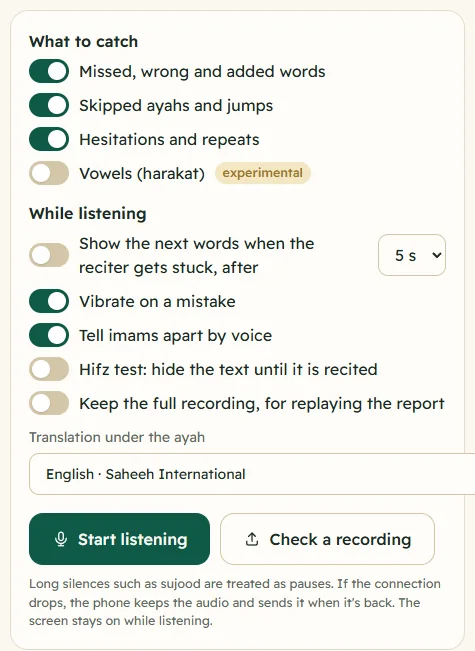
| Vowel may differ | Experimental. On a letter: expected one vowel, heard another. Only when Vowels (harakat) is on. Always check by ear. |
Information
| Finding | What it means |
|---|---|
| Started at | Where Samee first placed the recitation. |
| Paused | Six seconds or more of silence. After a pause the recitation may continue anywhere. |
| Continued at | Where it carried on after a pause. Al-Fatiha: a new rak'ah began marks the start of a rak'ah. |
| Sajdah of recitation | The pause after an ayah of prostration. |
| Du'a | A supplication, such as the qunoot of Witr. Not Quran text, so not checked. |
| Not Quran text | Isti'adha, takbir, Sami'a Allahu liman hamidah, Amin and similar. |
| Reciter | A different voice started reciting. |
| Couldn't place this | Speech Samee couldn't find in the Quran. |
These are explained for Taraweeh in rak'ahs, sajdah, qunoot and imams.
How sure is Samee?
- A finding marked N% sure is one Samee is less than 70% sure of.
- For missed, wrong and added words, Samee takes a second, closer listen to the audio. If that suggests the word was in fact recited, the finding is lowered to a minor note and says so, for example The recogniser missed this word, but a closer listen suggests it was recited. Not counted as a mistake.
- rarely right before means you have dismissed most findings of this kind before, so Samee stopped counting this kind as a mistake for you.
Samee follows the words of the riwayah of Hafs. Echo, noise, a quiet voice or a reciter far from the phone all make mistakes harder to hear. Findings are prompts to listen, not verdicts.
What Samee doesn't judge
Samee checks the words and, experimentally, the short vowels and shadda. It doesn't judge the finer rules of tajwid: the length of a madd, ghunnah, the exact articulation point of a letter, or where it is best to stop. For that, recite to a qualified teacher. The blog post lahn jali and lahn khafi explains the difference.
Review the findings
In the session's report, each finding has:
- Play, to hear the clip (and In the recording, when the full recording was kept);
- Confirm, if it really was a mistake;
- Dismiss, if it wasn't. It then leaves your statistics and practice list;
- Undo, to go back to not reviewed;
- Add a note, for anything to remember.
Your reviews also teach Samee: after eight or more reviews of one kind, if you dismissed most of them, new findings of that kind stop counting as mistakes. See review the session report.
Frequently asked questions
Which findings count as mistakes?
Missed words, wrong words, skipped ayahs, jumps to another place and added words. Sounded different, repeated, hesitated and vowel notes are minor and don't count, and pauses, sajdahs and duas are information only.
Samee marked a word as missed, but the reciter said it. Why?
The speech recogniser can miss a word in echo or noise. Samee double-checks missed, wrong and added words against the audio, and lowers them when the audio suggests the word was there. Listen to the clip and dismiss the finding if it's wrong.
What does N% sure next to a finding mean?
Samee is less than 70% sure of that finding. Listen to the clip before you act on it.
What does rarely right before mean?
You dismissed most earlier findings of this kind, so Samee no longer counts this kind as a mistake for you. It still shows them so you can check.
Was this article helpful?
Related articles
- Follow a Taraweeh imam or a student live, word by wordOn Listen, name the session and its track, choose where it starts and tap Start listening. Samee finds the place, follows each word and lists missed, wrong and skipped words as they happen.
- Show the next words when a reciter gets stuck (talqeen)Turn on Show the next words when the reciter gets stuck and pick 3, 5 or 8 seconds. When the reciter goes quiet mid-ayah, Samee shows the next few words on screen so you can prompt them.
- Taraweeh in Samee: rak'ahs, sajdah, qunoot and imams taking turnsSamee expects Taraweeh: a silent basmalah isn't a missed word, each rak'ah's Al-Fatiha is recognised, the sajdah and qunoot are labelled, and imams are told apart by voice.
- Test your hifz with hidden text, and the experimental vowel checkTurn on Hide the text while I recite in Practice, or the hifz test on Listen: words appear only once you recite them. After a practice attempt, Check my vowels flags harakat that may differ.
Need a hand?
Email us what you see on screen — a screenshot helps — and we'll walk you through it.